
If you live in a subdivision built in the last 30 years almost anywhere in greater Austin, you probably have an HOA. And if you have an HOA, almost any exterior project, fence, deck, pergola, patio cover, siding color change, even a paint refresh, needs architectural approval before you can start.
That's not a problem. It just adds a step. Here's what to expect, how long it takes, what to put in the packet, and how a local contractor handles all of this on your behalf so you don't have to learn the difference between a CCR, an ARC, and an estoppel certificate.
How Austin HOA approval works
Most Austin-area HOA architectural review processes have the same basic flow:
- You (or your contractor) prepare a submission packet. Site plan, elevations or examples, materials, finishes, and the HOA's own form.
- You send the packet to the HOA's Architectural Review Committee (ARC). Usually via email or an online portal. Some still want a physical copy.
- The ARC reviews and votes. Some review on a rolling basis, some only at a monthly meeting.
- You get an approval letter, a request for more info, or a denial. If approved, you're cleared to start once you have any required city or county permit. If denied, the letter usually tells you exactly why, and you revise and resubmit.
Most HOAs in Austin take 14 to 30 days end to end. A few are faster. A handful (especially older neighborhoods with a board that meets monthly) can take 30 to 60. Timing your submission to the right window in the month can save you weeks.
Skipping the paperwork sounds nice until you have to take down a finished deck. We handle every HOA submission as part of the project, from the site plan to the back-and-forth. Free, no obligation.
Talk to John →What goes in an Austin HOA architectural submission packet
The exact requirements vary by HOA, but a typical Austin-area submission for a fence, deck, or pergola includes:
1. The HOA's own application form
One to two pages, usually downloadable from the HOA's website. Lists the project type, your contact info, contractor info, expected start and end dates, and a place for you to sign acknowledging the CCRs.
2. A site plan or plat showing where the project will go
This is the trip-up for most homeowners. The HOA wants to see your full lot with the project drawn in, including dimensions and distances to property lines, easements, and the home. You can mark up a copy of the plat from your closing documents. Or, more commonly, a contractor will draft a quick site plan as part of the submission package.
3. Elevations or representative photos
An elevation drawing shows what the project will look like from the side. A 6-foot privacy fence elevation is usually a simple rectangle with the picket pattern shown. A pergola elevation shows post height, beam dimensions, and roof type. For most fence and deck projects, the HOA will accept a clear photo of a similar project instead of a formal drawing, as long as the photo accurately represents what's being built.
4. Material specifications
Spell out exactly what's being installed: cedar vs. pressure-treated, board-on-board vs. shadow-box vs. side-by-side, picket dimensions, post material, and stain or paint color. If the HOA's CCRs specify a finish color (lots in Austin do), include a paint or stain swatch with the brand name and color code.
5. Any required engineer or surveyor documents
Larger structures (attached patio covers, multi-story decks) sometimes require an engineer's stamp on the plans, which the HOA wants to see. A few neighborhoods near greenbelts also require a tree survey. These are rare but they happen.
How long does HOA approval really take?
Here's the honest answer from doing dozens of Austin-area submissions a year:
| HOA review style | Typical timeline | What to plan for |
|---|---|---|
| Rolling review (most modern HOAs) | 10 to 21 days | Submit any day, decision usually within 2 to 3 weeks. |
| Monthly board meeting | 15 to 45 days | Submit at least 7 days before the meeting. If you miss it, you wait a month. |
| Quarterly or "as-needed" board | 30 to 90 days | Older HOAs with no management company. Get on the agenda early. |
You don't get to pick which style your HOA uses. But you do get to plan around it. If you want a fence built in March, you need to submit by mid-January at the latest. If you want a pergola built before summer, submit in February.
The most common Austin HOA rules that trip people up
Fence height and material
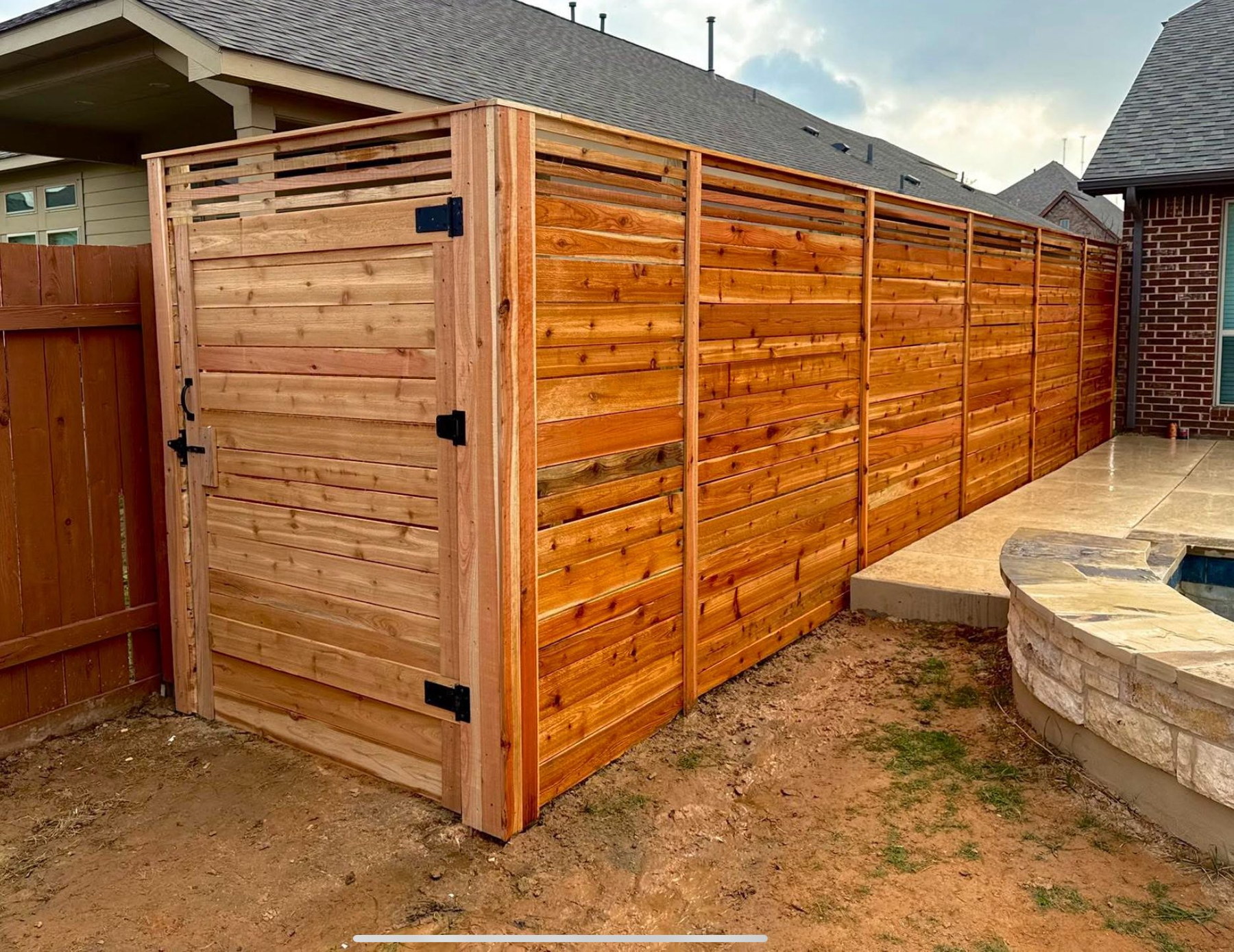
Almost every Austin-area HOA caps fence height at 6 feet on side and rear property lines and 4 feet (or no fence) on front. Most require cedar or composite, prohibit pressure-treated in visible runs, and specify that the "good side" of the fence faces out toward neighbors. Some Hill Country neighborhoods require split-rail or "ranch" style instead of solid privacy fence.
Setbacks from property lines
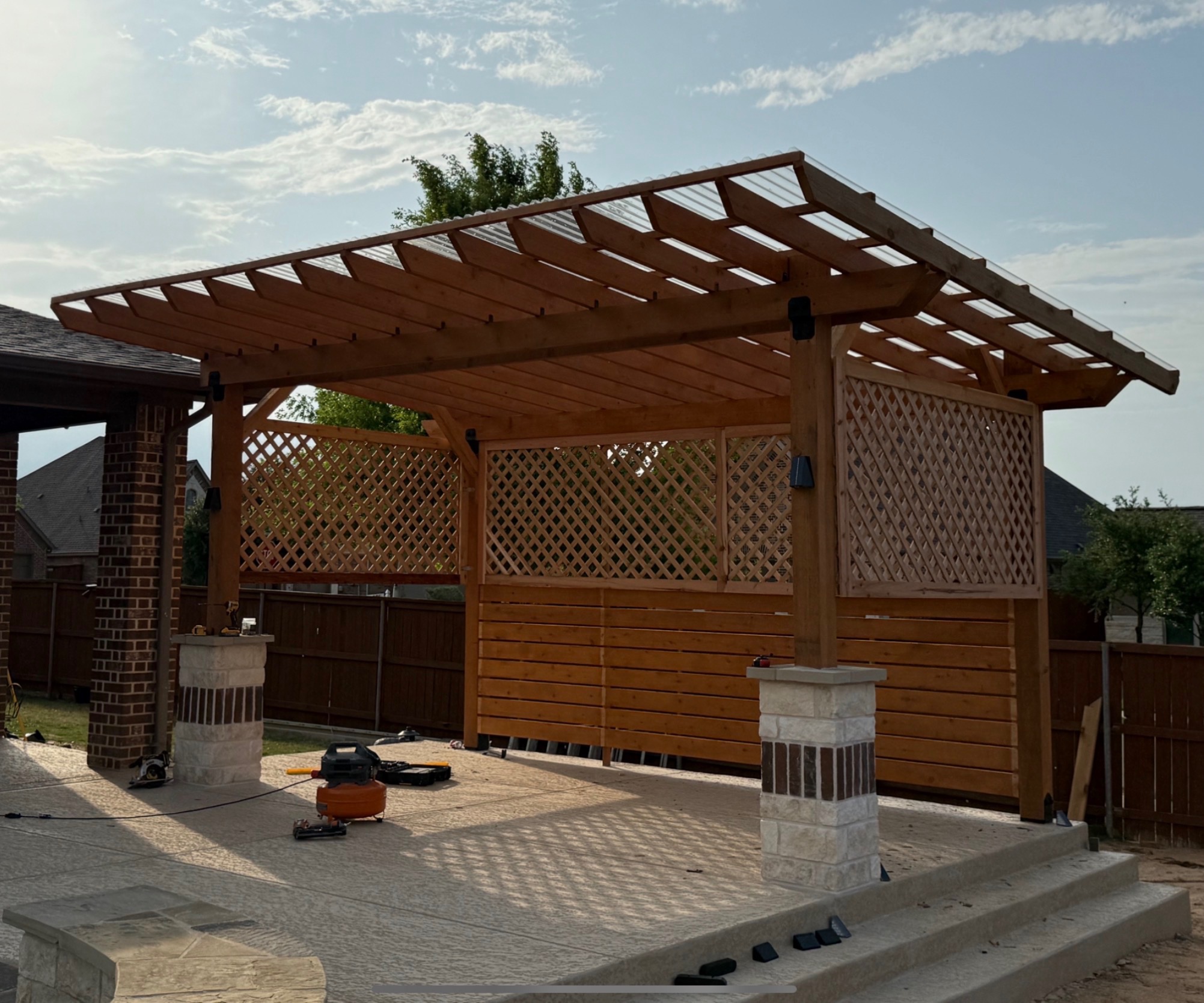
Most HOAs require structures (decks, pergolas, sheds) to be set back at least 5 feet from the side property line and 10 feet from the rear. Free-standing pergolas often have to be at least 5 feet from the house if they're not attached. These setbacks come from the deed restrictions, not the city code, and they're stricter in many neighborhoods.
Color and stain restrictions
This is the most-denied submission line item. Many HOAs require fences and pergolas to be left to weather naturally (no stain), or specify a short list of approved stains. Some prohibit white-painted pergolas in neighborhoods with a "Hill Country" aesthetic. Always check the CCRs before falling in love with a color.
Roof slope and material on patio covers
Attached patio covers often need to match the main roof slope and material. If your house has architectural shingles in "weathered wood," your patio cover roof probably needs the same. Metal patio covers are sometimes prohibited in shingled-home neighborhoods. Check before you design.
"Visible from the street" rules
Some Austin HOAs distinguish between "visible from the street" and "not visible." A pergola in your fully enclosed backyard might get rubber-stamped. The same pergola visible over the fence from the cul-de-sac might trigger extra scrutiny on color, height, and material. Photos from the street are sometimes part of the submission for this reason.
What happens if the HOA denies the project?
Denials are usually fixable. In our experience, the most common reasons are:
- Material or color doesn't match the CCRs. Usually a quick fix: change to an approved color or specify the right material.
- Setback issue. The drawing shows the project too close to a property line. Often solved by moving the structure 1 to 3 feet.
- Missing or unclear documents. The site plan didn't show all dimensions, or the elevations didn't match the actual build. Easy fix, just resubmit with corrections.
- HOA wants more visual context. They want a photo of a similar finished project, a stain swatch, or a sample of the picket. Send it and you're approved.
A true "we will never approve this" denial is rare and usually shows up on submissions that are way outside the CCRs, like a 10-foot fence in a 6-foot neighborhood or an aluminum patio cover in an all-cedar HOA. Most denials are paperwork problems, not project problems.
If a denial does stick, Texas law gives you a next step. In an HOA with more than 40 lots (once the developer has handed over control), a denial has to come in writing and explain the reason, and you can ask for a hearing with the HOA board within 30 days of the notice. The board then has to hold that hearing within 30 days of your request. That rule is in Texas Property Code Section 209.00505.
Can you build without HOA approval?
Technically you can put pickets in the ground without an approval letter. We strongly recommend you don't. HOAs in Texas can fine you, force you to remove unapproved work at your expense, and put a lien on the home. We've seen people pay to tear down brand-new decks because they skipped the submission. The 14 to 30 days of waiting is much cheaper than the alternative.
Which Austin-area HOAs are the strictest?
Without naming specific neighborhoods, here's the pattern:
- Older, established neighborhoods (especially in West Austin, Northwest Hills, Lakeway, Westlake) tend to have monthly or quarterly review, stricter material rules, and longer back-and-forth. Plan for 4 to 8 weeks.
- Newer master-planned communities (most of Round Rock, Cedar Park, Pflugerville, Buda, Kyle) usually have rolling online submission portals and 10 to 21 day turnarounds. The CCRs are detailed but predictable.
- Hill Country / acreage neighborhoods often have lighter HOAs but strict natural-aesthetic rules: cedar only, no painted finishes, ranch-style fencing only.
- Travis County unincorporated often has no HOA at all but stricter county rules around impervious cover, well setbacks, and septic field clearances.
Every neighborhood is different. Before you start designing, pull up your CCRs (your closing documents have them, or your HOA management company can send a fresh copy). The 30 minutes of reading is worth it.
How we handle HOA submissions on every project
This is the part we genuinely don't think clients should have to deal with. So we don't make them. Here's our process:
- At the estimate visit, we ask about your HOA. Name, management company, and whether you have a copy of the CCRs handy. We can usually find the rest online.
- We review the CCRs and tell you what's possible. If your dream design conflicts with the CCRs, we'll tell you up front and suggest alternatives that will get approved.
- We prepare the full architectural review packet. Site plan, elevation, material specifications, color samples, the HOA's own form, and any neighborhood-specific extras.
- We submit to the HOA on your behalf. You sign once and we handle the rest, including following up with the ARC if they don't respond.
- If revisions are needed, we revise and resubmit. We don't charge extra for this. It's just part of the job.
- Once approved, we pull the city or county permit and start the work. No surprises, no delays.
For most projects, this adds zero hassle for you and 2 to 5 hours of paperwork on our end. That's a fair trade for not having to learn HOA Robert's Rules in your spare time.
Got an HOA project in mind? Tell us about it. We'll review your CCRs, design something that will actually get approved, and handle the entire submission. Free quote, no obligation.
Talk to John →How long Austin HOA approval really takes
HOA approval in Austin sounds scarier than it is. Most submissions take 2 to 4 weeks, the rules are predictable if you read them, and the actual paperwork is one to three pages plus some drawings and specs. The two things that turn a smooth approval into a nightmare are bad paperwork and a project that conflicts with the CCRs. A good local contractor solves both, because we've seen this packet a thousand times and we know what the ARC actually wants.
If you're planning a fence, deck, pergola, siding change, or any other visible exterior project, don't let HOA worry stop you from getting started. Call us, send us a quick description, and we'll tell you within a day what's possible in your neighborhood and how long approval will likely take. Then we handle the rest.
HOA approval questions from Austin homeowners
How long does HOA approval take in Austin?
Most Austin-area HOAs take 14 to 30 days to review and approve a standard architectural submission. Some review monthly, so timing your submission to the right window can save 2 to 3 weeks. Complex projects or HOAs that require board votes can run 30 to 60 days.
What do I need to submit to my HOA for a fence or deck?
A standard Austin HOA architectural review submission includes a site plan showing the location, an elevation drawing or photo example, material specifications (cedar, treated pine, paint or stain color), and a plat or survey of your lot. Most HOAs have a one-page form to attach to that package.
Will my contractor handle the HOA submission for me?
A good local contractor should. We prepare and submit the architectural review packet as part of every project, including site plan, elevations, material specs, and color samples. You sign once and we handle the back-and-forth with the HOA.
What happens if my HOA denies the project?
Denials are usually fixable. The most common reasons are material or color non-compliance, setback issues, or missing documents. We revise the submission based on the denial letter and resubmit, which typically gets approval on the second pass.
Still choosing who to build it? See the Austin contractor hiring playbook.
On an HOA board or managing a community? See how we work with HOAs and community managers.
Sources
- Texas Property Code, Section 209.00505, Texas Legislature: written denial notices and the owner’s right to request a board hearing for HOAs with more than 40 lots.
Rules change, so we check which ones apply to your address before every build. New to a term? See our plain-English glossary.