

A deck should make your backyard feel finished. It should be somewhere your family wants to spend a Saturday. We've been building decks across the greater Austin area for years, and we've learned that the ones that last come down to good lumber and careful framing.
Decks we build in Austin
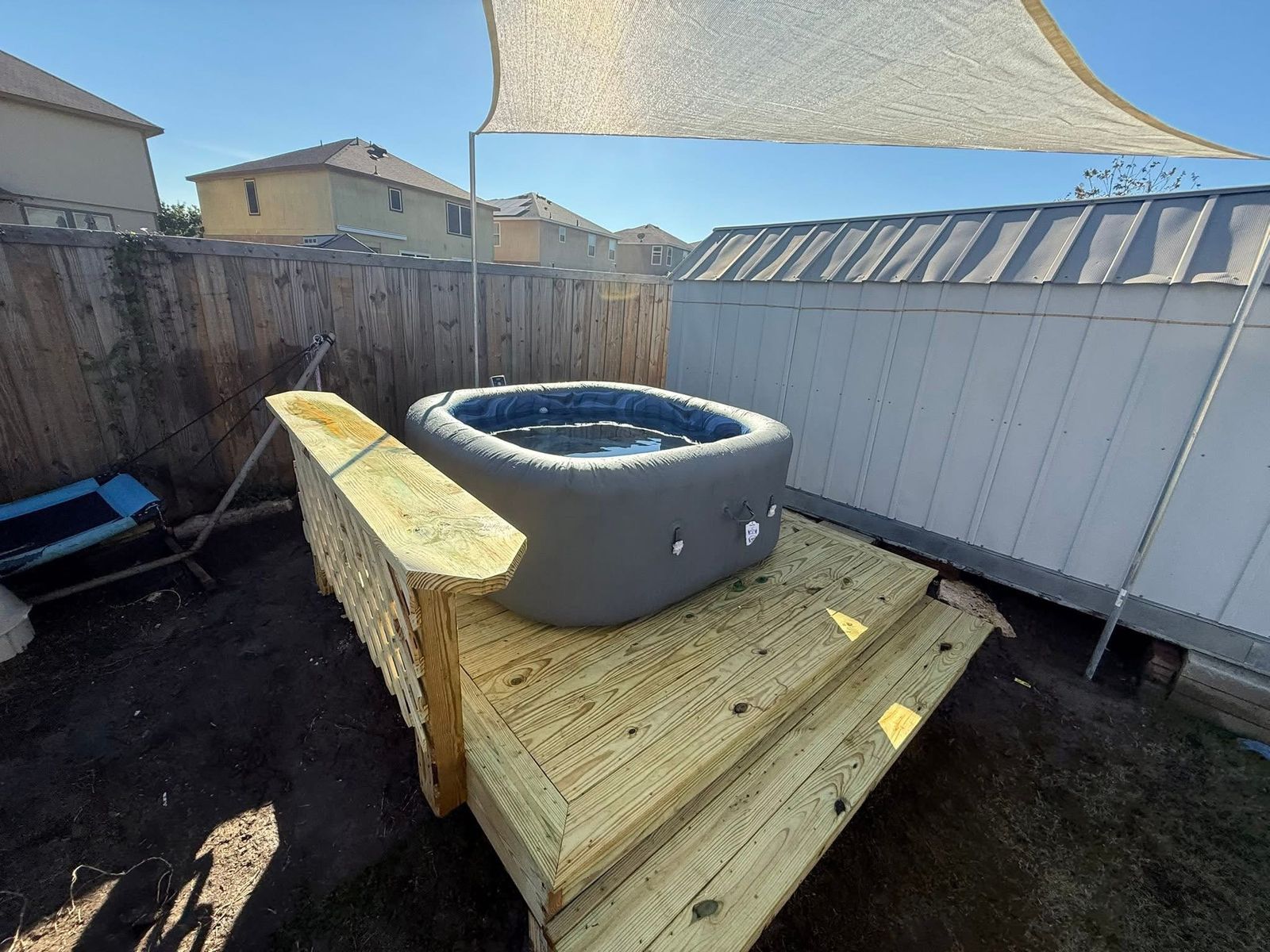
- Pressure-treated pine decks: the workhorse. Affordable, durable, and great for big footprints. Lasts 15 to 20 years in Austin's climate.
- Western Red Cedar decks: warmer color, naturally rot-resistant, no chemicals. Our most popular upgrade.
- Composite and PVC decking: Trex, TimberTech, and similar. Lowest maintenance, longest lifespan, premium look.
- Multi-level decks, wraparound porches, and elevated decks: built for sloped Hill Country lots.
- Built-in benches, planters, lighting, and pergola integrations: built right into the framing, not bolted on after.
- Stairs, landings, and railings: code-compliant, comfortable rise and run, pickets done right.
What a deck costs in Austin
Most contractors will tell you "it depends." It does, but that is not an answer you can plan around. Here is where our Austin deck builds land, installed:
Installed, including framing, fasteners, and labor. Height, railings, stairs, and site access move the number, which is why we measure before quoting. See the full cost breakdown
Choosing a decking material for Austin heat
Austin asks more of a deck than most climates do: 100-degree afternoons for weeks at a stretch, hard UV, then a week of rain that swells everything back up. Here is how the three materials we build with behave here.
| Material | Installed cost | Realistic lifespan | Upkeep | Barefoot in August |
|---|---|---|---|---|
| Pressure-treated pine | $30 to $45 / sq ft | 15 to 20 years | Re-stain every 2 to 3 years | Comfortable |
| Western Red Cedar | $50 to $75 / sq ft | 20 to 30 years | Re-stain every 2 to 4 years | Coolest of the three |
| Composite & PVC | $60 to $100 / sq ft | 25 to 50 years | Wash it, that's all | Hot in direct sun |
Pressure-treated pine
The value build, and there is no shame in it. The framing under a cedar deck and a pine deck is the same lumber anyway. What you give up is the surface: pine moves more, checks more, and wants a fresh coat of stain every couple of years. What you get is the biggest deck per dollar, which matters if the goal is a 400-square-foot entertaining space rather than a small landing. Our guide to when to stain a deck covers how long to wait on new wood and how often to recoat.
Western Red Cedar
Our most popular upgrade, and the one we recommend most often for Austin. It has natural oils that resist rot and insects without chemical treatment, it takes stain beautifully, and it stays noticeably cooler underfoot than composite. If your deck gets full west sun and anyone in the house walks barefoot, cedar is the right answer.
Composite and PVC
If you never want to pick up a stain brush again, this is the one. Modern capped composite holds color far better than the early generation did. The honest tradeoff is heat: a dark composite board in full Austin sun in July gets hot enough that you will want shoes. Lighter colours and a pergola over the top both help a lot.
What actually moves the price
Square footage is only the starting point. These are the things that change an Austin deck quote the most, and the things a vague quote tends to hide:
- Height off grade. A deck 18 inches off the ground and a deck 8 feet off the ground use wildly different framing, footings, and railing. Elevation is usually the single biggest cost driver.
- Stairs. Every run of stairs is framing, treads, railing, and a landing. Two sets of stairs can add more than a hundred square feet of deck would.
- Railing choice. Wood pickets are the baseline. Cable, steel, and glass climb fast, and on an elevated deck you need a lot of linear feet of it.
- Site access. If the crew can back a trailer to the build, material handling is cheap. If everything goes through a 36-inch gate by hand, that is real labour.
- Demolition. Tearing out and hauling an old deck is its own line item, and rotted footings sometimes have to come out with it.
- Soil and footings. More on this below. It is the part of the quote most homeowners never think to ask about.
Austin-specific things that catch people out
Our soil moves
Central and east Austin sit on expansive clay that swells when it rains and shrinks when it doesn't. That movement is exactly what lifts and cracks slabs, and it is why footing depth is not a detail to cut corners on. West of MoPac you run into limestone and caliche instead, which is stable but hard to dig and sometimes needs different equipment. We plan footings around what is under your yard, which is part of why we measure on site instead of quoting off a satellite photo.
Permits
The City of Austin generally requires a permit for a deck attached to the house or raised meaningfully off the ground, and the surrounding cities each have their own thresholds. We pull permits as part of the project rather than leaving it to you, and we would rather pull one that turns out to be unnecessary than skip one that wasn't.
Protected trees
Austin takes its tree ordinance seriously, and a lot of the best backyards in town have a big live oak right where the deck wants to go. Larger trees are protected, and digging footings inside the root zone of one can require review before anything happens. We work around this constantly. Often the answer is shifting the footing plan or cantilevering the framing so the deck reaches past the tree without putting a pier into its roots.
Impervious cover
Austin zoning limits how much of a lot can be covered by impermeable surfaces, and how a deck counts toward that limit depends on how it is built. A deck with gapped boards over permeable ground is treated very differently from a slab. If your lot is already near its limit, the way we detail the deck can be the difference between an approved plan and a redesign.
Drainage
When Austin rains, it rains all at once. We look at where water currently goes before we set a single post, because a deck that dams up the natural drainage path turns the yard behind it into a swamp and rots the framing from underneath.
Still deciding on a layout? Our Austin deck design ideas guide walks through ground-level, raised, multi-level and covered decks with photos of real builds.
How to vet an Austin deck builder
You are going to get quotes from several people. Here is what we would ask all of us, including us:
- Is the quote line-itemed? A single number with no breakdown is not a quote, it is a guess you cannot compare against anyone else's.
- Who pulls the permit? If the answer is "you don't need one" on an attached or elevated deck, keep calling.
- How deep are the footings, and why that depth? A builder who has thought about your soil will have a real answer.
- What hardware are you using? Fasteners and joist hangers in contact with treated lumber have to be rated for it or they corrode. This is the cheapest part of the build and the most expensive to redo.
- Is it cedar, or pine stained to look like cedar? Ask directly. The price difference is significant and the substitution is common.
- What does the warranty say? Get it in writing, and read what it covers besides the boards.
- Can I see a build from three years ago? A new deck always looks good. A three-year-old one tells you the truth.
Where we build decks around Austin
We build decks across greater Austin and the surrounding counties. In town we work regularly in South Austin, Circle C, Travis Heights, Barton Hills, Crestview, Allandale, Mueller, and out along the 360 and 2222 corridors.
Have a backyard in mind? Use the Design Builder to pick a style, material, and finish. We'll come measure for free and write you a real, line-itemed quote. Call or text anytime.
Design my deckHow a JB deck project goes
- You design or call. Use the on-site Design Builder to sketch what you want, or just call us at (512) 587-3914. Call or text John anytime.
- Free on-site walk-through. John comes out, measures, asks the right questions, and writes a line-itemed quote. No pressure, no obligation.
- We pull the permits. Most Austin decks need one. We handle it.
- Build day. Crew shows up on time. John texts daily progress photos.
- Walkthrough & warranty. We finish, clean up, walk every detail with you, and back it in writing.
Full deck cost breakdown for Austin
We wrote a full pricing breakdown for Austin decks: pressure-treated vs. cedar vs. composite, what really moves the price, and what to ask any contractor before signing. Read the 2026 Austin deck cost guide
See recent decks
Our backyard, hill-country, and wraparound deck builds across greater Austin. Browse the project gallery
Recent deck work
Austin deck questions, answered
Who builds decks in Austin, TX?
JB Contracting ATX builds pressure-treated pine, cedar and composite decks across greater Austin, including South Austin, Circle C, Travis Heights, Barton Hills, Crestview, Allandale and Mueller. We are family owned, licensed and insured, and rated 5.0 on Google. Owner John Bernard walks every estimate himself and writes a free, line-itemed quote.
How much does a new deck cost in Austin?
Pressure-treated decks in Austin typically start around $30 to $45 per square foot installed, cedar runs $50 to $75 per square foot, and composite materials run $60 to $100 per square foot. Final pricing depends on height, railings, stairs, site access, and whether you want built-ins like benches, planters, or lighting. We measure the space and hand you a line-itemed quote so you can see exactly what each piece costs.
How long does it take to build a deck in Austin?
Most residential decks take 1 to 3 weeks of build time once permits are pulled. Smaller pressure-treated decks can wrap in under a week. Larger multi-level cedar or composite builds with built-in lighting or benches take longer. You get a firm timeline at the estimate, and John texts daily progress photos while the crew is on site.
Do I need a permit to build a deck in Austin?
In most cases, yes. The City of Austin generally requires a permit for any deck attached to a home or raised meaningfully off the ground, and each surrounding city sets its own threshold. We handle the permit process as part of every project we build, including the HOA architectural review submission when your neighborhood requires one.
What's the best decking material for Austin's climate?
For Austin's heat, sun, and occasional storms, the three best choices are pressure-treated pine (most affordable, 15 to 20 year lifespan), Western Red Cedar (warmest look, naturally rot-resistant, 20 to 30 years with upkeep), and composite or PVC (lowest maintenance, 25 to 50 years, no staining). Cedar is our most popular upgrade because it handles the heat well and stays cooler underfoot. Composite makes the most sense if you never want to re-stain.
Can you build a deck around a protected tree?
Usually, yes, and we do it often. Austin protects larger trees, and digging footings inside the root zone of one can require review before work starts. The usual solution is to redesign the footing layout or cantilever the framing so the deck reaches past the tree without putting a pier through its roots. We sort this out during the estimate rather than discovering it mid-build.
Can you build on a sloped or Hill Country lot?
Yes. Elevated and multi-level decks are a good part of what we build west of town, where lots fall away fast. We engineer the footings for the actual grade and build out over the slope instead of fighting it, which usually turns the least usable part of the yard into the best part of the house.
Do you replace old decks as well as build new ones?
Yes, and it is a large share of our work. We tear out and haul the old structure, inspect the footings and ledger, and rebuild. Most failed decks in Austin go at the ledger connection and the posts first, not at the boards you can see from the back door, so a deck that merely looks tired is sometimes structurally fine and a deck that looks fine sometimes isn't.
What time of year is best to build a deck in Austin?
We build year round. Winter and early spring are the easiest to schedule and the most comfortable to work in, and booking then usually means your deck is finished before the season you want to use it. Late spring is our busiest stretch, so lead times run longer. We wrote more about timing here.
Ready to start? Free quote, call or text anytime. Call (512) 587-3914 or design your project online.
Get my free deck quoteBuilding outside central Austin? Pricing, permits and HOA rules genuinely differ by city, so go straight to the local page: deck installation in Buda, deck building in Round Rock, or elevated decks in Cedar Park. Each has local pricing, HOA notes and the neighborhoods we build in. Weighing a deck against the alternatives? Deck vs patio vs pergola lays out the tradeoffs.
Want the deck shaded? See patio covers in Austin. Building the deck and the cover together is dramatically cheaper than adding a roof to a deck that was not framed to carry one.
Thinking about the whole backyard? See outdoor living in Austin, which covers building the deck, the cover and the concrete as one project instead of three.
Choosing composite? Our Trex vs TimberTech vs Fiberon comparison covers each brand's lines, heat and installed cost.
Not sure your old deck needs replacing? Our guide to deck repair cost in Austin explains what repairs cost and how to tell a repair from a rebuild.