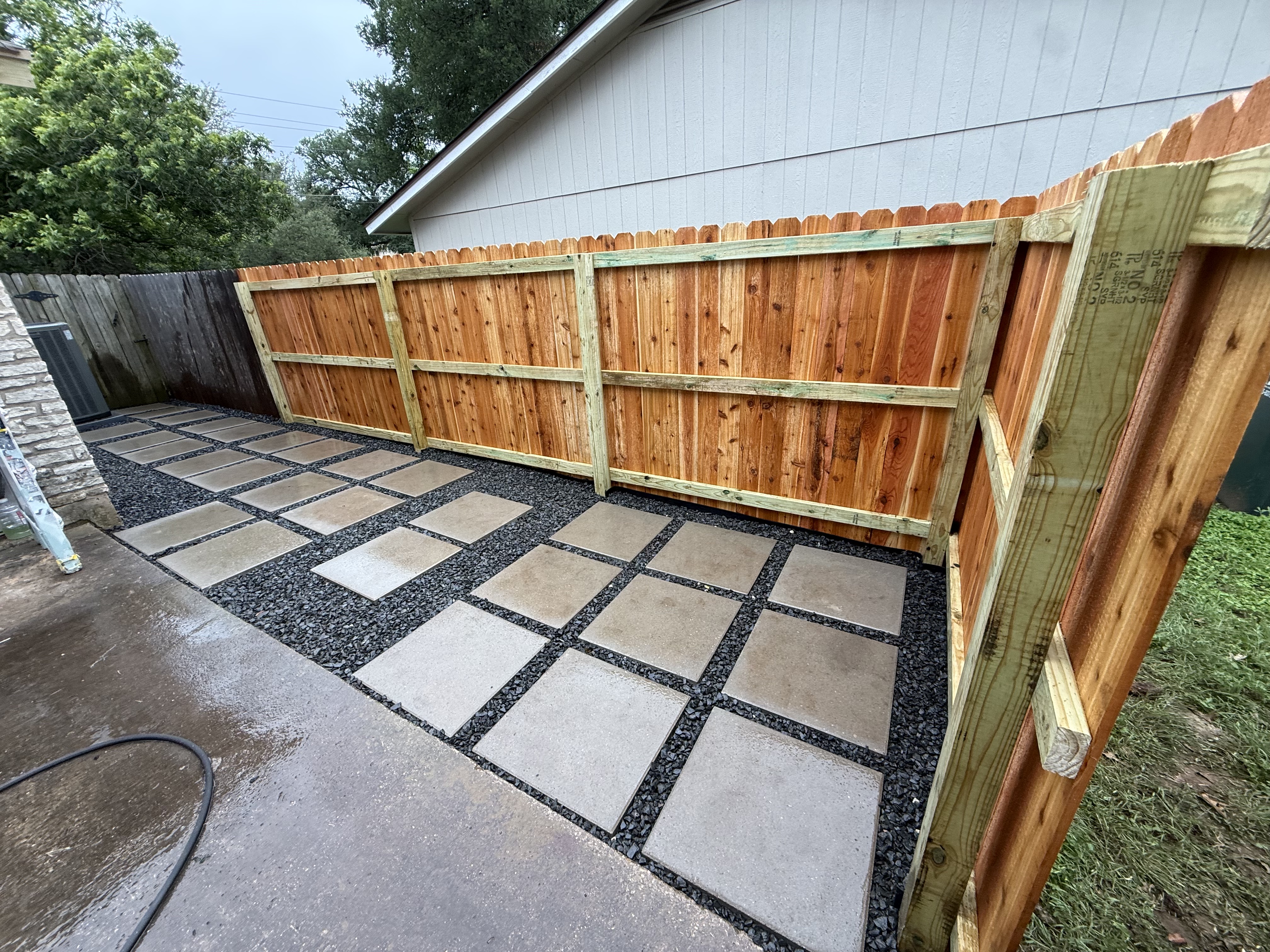
Hardscape is the foundation of any real outdoor living space. The patio you set the table on, the path you walk to the firepit, the wall that turns a slope into a usable yard. We install all of it: poured concrete, stamped and stained finishes, pavers, flagstone, retaining walls, and the fire features that make a backyard feel finished.
Hardscape we install in Austin
- Concrete patios: standard pour, stamped, stained, broom-finished, or salt-finished.
- Paver patios & walkways: brick, concrete pavers, and natural stone in any pattern.
- Flagstone patios: for that natural Hill Country look.
- Fire pits & outdoor fireplaces: wood-burning or gas, stone or stucco, freestanding or pavilion-integrated.
- Retaining walls: block, stone, or poured concrete to turn slopes into usable backyard.
- Outdoor kitchens & bar tops: concrete countertops, tile, or stone, plumbing and gas roughed in.
- Cover-ready slabs: if you're planning a future patio cover or pergola, we pour with the footings sized right from day one.
What hardscape costs in Austin
Concrete is priced per square foot and the finish drives most of the spread. These are the ranges we are quoting right now, installed.
| Patio type | Per square foot, installed | Typical 400 sq ft patio |
|---|---|---|
| Standard broom-finish concrete | $8 to $15 | $3,200 to $6,000 |
| Exposed aggregate | $12 to $20 | $4,800 to $8,000 |
| Stained concrete (acid or water-based) | $13 to $20 | $5,200 to $8,000 |
| Stamped concrete (any pattern) | $15 to $25 | $6,000 to $10,000 |
| Stamped + stained / decorative | $18 to $30 | $7,200 to $12,000 |
Pavers and flagstone are labour-heavy and generally land above stamped concrete. See the full 2026 patio cost guide →
Concrete, pavers, or flagstone?
Poured concrete
The most patio per dollar, and with a stamp or stain it does not have to look like a driveway. One continuous surface means no weeds through joints and nothing to re-level. The tradeoff is honest: concrete in Austin will develop hairline cracks. Control joints decide where they go, not whether they happen.
Pavers
Individually set units over a compacted base. They cost more because it is far more labour, and they buy you two real advantages: our clay can move without cracking anything, because the joints absorb it, and a damaged section can be lifted and reset instead of patched. Expect to re-sand joints occasionally and to pull the odd weed.
Flagstone
The Hill Country look, and nothing else quite matches it next to limestone and cedar. Irregular thickness makes it the slowest to lay and the most expensive per square foot. Set properly on a mortar bed or a deep compacted base it lasts decades; set on sand over clay it will rock underfoot within a couple of seasons.
What decides whether a patio lasts in Austin
- The base, not the surface. Nearly every failed patio we replace failed underneath. Clay compacted properly and to the right depth is the whole job; everything above it is finish.
- Thickness and reinforcement. Four inches is standard for a patio. Fibre mesh helps with surface cracking, rebar on a grid is what holds a slab together across our clay when it moves.
- Control joints. Concrete cracks. Joints cut at the right spacing and depth, early enough, decide that it cracks in a straight line you meant rather than diagonally across the middle.
- Slope. A patio needs fall away from the house, roughly a quarter inch per foot. Poured flat, it sends water at your foundation, which is a far more expensive problem than the patio.
- Curing. Concrete poured in an Austin August and left to dry in the sun loses strength. It wants to cure slowly and damp, and summer pours need to be managed for it.
Austin-specific things worth knowing
Impervious cover
Austin zoning limits how much of a lot can be covered with impermeable surface, and a big concrete patio counts against that limit. If your lot is already near its cap, the choice between poured concrete and a permeable paver system can be the difference between an approved plan and a redesign. Worth checking before you fall in love with a layout.
Our clay moves
Central and east Austin sit on expansive clay that swells and shrinks through the year. It is why slabs crack and why patios that were flat in March rock in September. It does not mean concrete is a bad choice here, it means the base and the reinforcement have to be done properly, and anyone quoting you a patio without asking about your soil has not thought about it.
Retaining walls and drainage
A retaining wall holds back soil, and wet soil is enormously heavier than dry soil. Walls fail when water builds up behind them with nowhere to go. Gravel backfill and drainage pipe are not optional extras on a wall of any real height, and past a certain height a wall needs engineering, not just stacking.
Heat
Dark stained concrete in full Austin sun gets genuinely hot underfoot in July. Lighter colours, a broom or salt finish, or planning a cover over part of the patio all help. It is worth thinking about before you pick a colour you will only see in a photo.
Where we do hardscape work around Austin
We do hardscape across Austin, Round Rock, Cedar Park, Pflugerville, Leander, Georgetown, Lakeway, Buda, Kyle, and Dripping Springs, and the rest of Travis, Hays, and Williamson counties.
Got a backyard project in mind? Use the Design Builder to pick a style and material. We'll come measure for free.
Design my hardscape →Ready for a quote? Call (512) 587-3914. Call or text anytime every time.
Get my free hardscape quote →Hardscape questions from Austin homeowners
How much does a concrete patio cost in Austin?
A standard broom-finish concrete patio in Austin runs $8 to $15 per square foot installed, which puts a typical 400-square-foot patio between $3,200 and $6,000. Stained runs $13 to $20, stamped $15 to $25, and stamped plus stained $18 to $30. Size, thickness, base prep and any poured-in footings for a future cover all move the number.
Pavers or concrete patio, which is better?
Concrete gives you the most patio per dollar and, stamped or stained, it does not have to look plain. Pavers cost more because they are far more labour, and they buy you movement tolerance on our clay and the ability to lift and reset a damaged section rather than patch it. If budget is the priority, concrete. If your soil moves a lot or you want a repairable surface, pavers.
Will my concrete patio crack?
Almost certainly it will develop hairline cracks, and that is normal for concrete on Central Texas clay. What good work controls is where. Control joints cut at the right spacing and depth, early enough, give the slab a planned place to crack so it goes in a straight line instead of diagonally across the middle. Proper base prep and rebar are what keep those cracks hairline rather than structural.
Do I need a permit for a patio in Austin?
A simple at-grade patio usually does not need a building permit, but it does count toward your lot's impervious cover limit, and that is the constraint that catches people out. Retaining walls above a certain height, and anything structural like an outdoor kitchen or fireplace, generally do require permits. We check what applies to your address and pull whatever the project needs.
Can you pour a slab now and add a cover later?
Yes, and if a cover is anywhere in your plans this is the right way to do it. We size and place the footings for the posts while the slab is going in. Retrofitting footings into finished concrete later means coring through your new patio, which costs more and never looks as clean.
How long does a patio take to install?
Most concrete patios are demo, prep, pour and finish within about a week, then the slab needs time to cure before heavy use, usually a week or so more depending on weather. Pavers and flagstone take longer because every unit is set by hand. We give you a firm timeline at the estimate and text progress photos as we go.
Planning a cover over it? See pergolas and patio covers, or compare your options in deck vs patio vs pergola.