
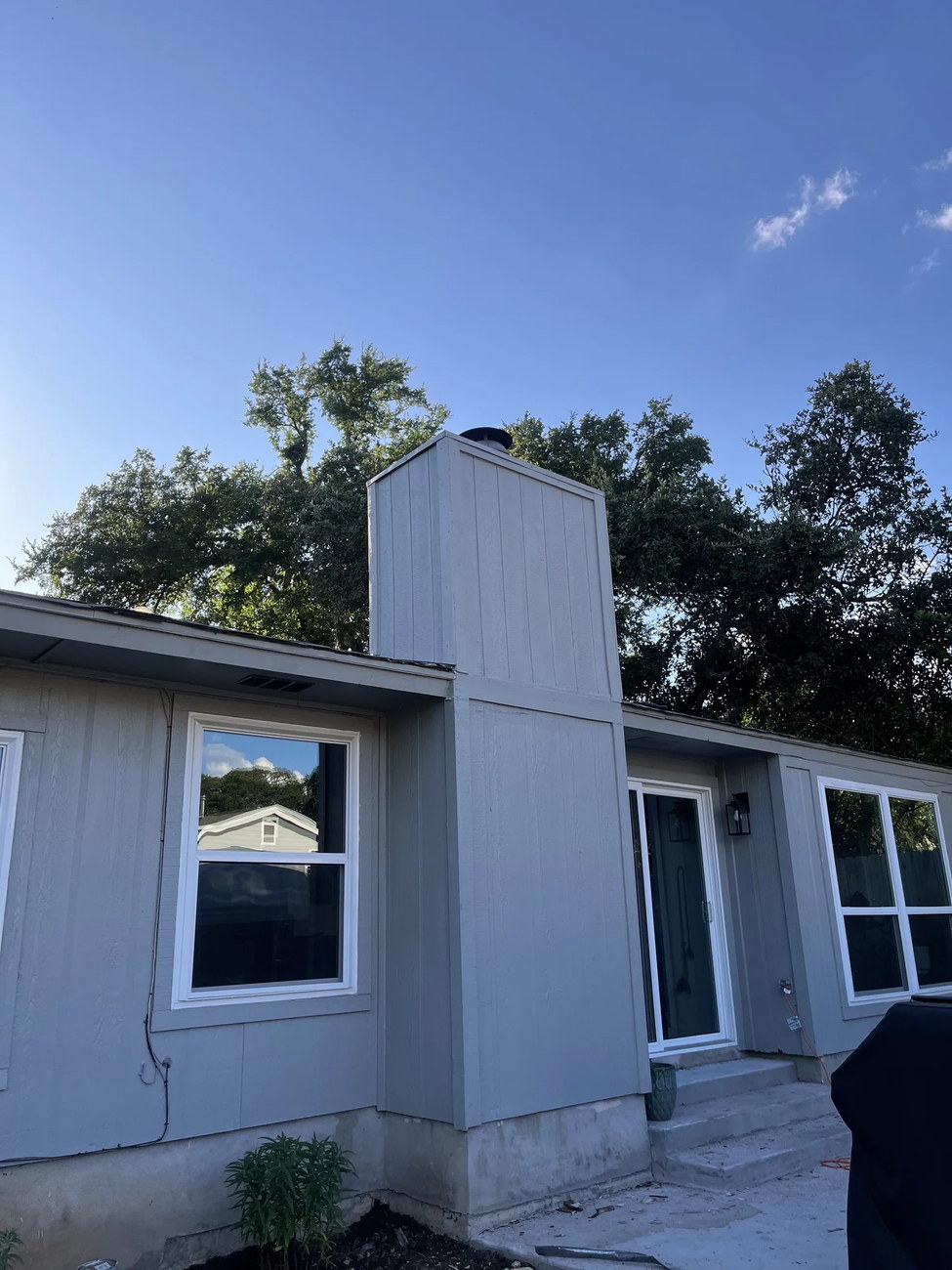
Siding is the single biggest visual change you can make to a home, and one of the highest-ROI projects you can do. Done right, it transforms curb appeal, seals the house against weather, and pays back most of its cost at resale. Done wrong, it traps moisture, peels paint, and looks worse than what you started with. We do it right.
Siding services we install in Austin
- Hardie fiber cement siding: the Austin standard. Doesn't rot, doesn't warp, holds paint 15+ years, fire-resistant.
- Engineered wood siding (LP SmartSide and similar): warm wood look with composite durability.
- Cedar and real wood siding: for craftsman, modern farmhouse, and Hill Country builds.
- Gable-end and partial replacements: if only part of the home needs siding work, we don't sell you a full re-side.
- Trim, soffit, fascia, and house wrap: the parts most contractors cut corners on. We don't.
- Repaints during reside: two-coat exterior paint with the right primer for whatever substrate is going on.
What siding costs in Austin
Siding is priced by wall area, not by the floor area of the house, which is why a two-storey home costs far more than double a single storey of the same footprint. Staging, access, and the amount of trim all move the number.
| Home size | Typical Hardie re-side | Premium / complex |
|---|---|---|
| 1,500 sq ft (single storey) | $17,000 to $26,000 | $26,000 to $36,000 |
| 2,000 sq ft (single storey) | $22,000 to $34,000 | $34,000 to $46,000 |
| 2,500 sq ft (two storey) | $30,000 to $44,000 | $44,000 to $62,000 |
| 3,000+ sq ft (two storey, complex) | $38,000 to $58,000 | $58,000 to $80,000+ |
Roughly $10 to $16 per square foot installed, including tear-off, weather barrier, trim, and paint. See the full 2026 Hardie siding cost guide →
Choosing a siding material for Central Texas
Austin is unusually hard on cladding: long stretches of direct UV, big humidity swings, hail most springs, and an active termite population. Here is how the realistic options hold up.
Fiber cement (James Hardie)
Our default recommendation and the large majority of what we install. It has no organic material to rot or swell, termites have no interest in it, it holds paint far longer than wood under our sun, and it takes hail far better than vinyl. It costs more up front than the alternatives and it is what we would put on our own houses here.
Engineered wood (LP SmartSide and similar)
Lighter, easier to cut, and warmer looking than fiber cement, at a somewhat lower installed cost. It is treated wood product rather than cement, so the bottom-edge and cut-end detailing matters more. Done properly it performs well; done carelessly it fails the same way hardboard does.
Real cedar
Beautiful, and right for certain Hill Country and craftsman homes. Understand the maintenance you are signing up for: in this sun it wants refinishing every handful of years, and that is a recurring cost most homeowners underestimate at the quote stage.
Vinyl
We rarely recommend it here. It cracks under hail, and dark colours can distort in sustained heat against a south or west wall. It is cheap for a reason.
Why builder-grade siding fails in Austin
A very large share of the re-sides we do are on homes built in the late 90s and 2000s, where the builder used masonite or hardboard on the elevations the street doesn't see. That material absorbs water at its cut edges. Twenty years of wet-dry cycling later it swells, delaminates, and quietly lets water past into the sheathing. By the time the paint is visibly failing there is usually rot behind it.
The tells are worth knowing: a bottom edge that looks thicker or furry compared to the rest of the board, paint that will not hold no matter how often it is redone, soft spots you can press with a thumb, and dark staining below window corners. If you have any of those on one elevation, the others are usually a few years behind.
What separates a good siding job from a cheap one
- What happens when they find rot. On a twenty-year-old house, some bad sheathing is likely. Get the per-sheet repair rate in writing before you sign, or you will be renegotiating with the walls already open.
- The weather barrier. New house wrap and properly integrated flashing at every window and door. This is invisible once the siding is on, which is exactly why it gets skipped.
- Clearance at grade. Fiber cement needs a specified gap between the bottom course and the ground or any hard surface. Installed tight to the dirt it wicks moisture and voids the manufacturer warranty. It is the most common fault we find on cheap re-sides.
- Fastener placement. Blind-nailed at the correct spacing, not face-nailed through the middle of the board because it was faster.
- Factory finish or site paint. ColorPlus arrives finished with a long finish warranty and only needs touch-up at cut ends. Site painting gives you any colour and costs less up front, but you are relying on the paint job. Both are legitimate; know which you are buying.
How a JB siding project goes
- Free on-site inspection. John walks every elevation, checks the bottom courses and trim, and finds the soft spots that show where water has been getting in.
- Line-itemed quote. Material, tear-off, disposal, sheathing repair rate, trim, and paint, all separated.
- HOA submission. Most Austin-area subdivisions review exterior colour changes. We prepare the packet.
- Tear-off and inspection. The old material comes off and we find out what the sheathing really looks like.
- Weather barrier and flashing. The part that determines whether this lasts twenty years.
- Install, trim, caulk, paint. Correct spacing, correct clearances, correct joint detailing.
- Cleanup and walkthrough. Magnet sweep for fasteners, then we walk every elevation with you.
Most full re-sides run one to three weeks. Single-elevation and gable-end work usually wraps in under a week.
Where we do siding work around Austin
We side homes across Austin, Round Rock, Cedar Park, Pflugerville, Leander, Georgetown, Lakeway, Buda, Kyle, and Dripping Springs.
Want a fresh exterior? Use the Design Builder to pick a siding type, color, and trim. We'll come measure for free.
Design my siding →Ready to talk siding? Call (512) 587-3914. Call or text anytime, free on-site quote.
Get my free siding quote →Siding questions from Austin homeowners
How much does Hardie siding cost in Austin?
Hardie fiber cement siding in Austin typically runs $10 to $16 per square foot installed, including tear-off, house wrap, trim, and paint. A full re-side lands around $17,000 to $26,000 on a 1,500-square-foot single storey, $22,000 to $34,000 at 2,000 square feet, and $30,000 to $44,000 on a 2,500-square-foot two storey. Complex elevations and heavy trim work push those higher.
How long does a siding replacement take?
A full siding replacement on an average Austin home takes 1 to 3 weeks depending on size, prep work, and weather. Partial replacements such as gable ends or a single wall typically wrap in 3 to 5 days. HOA colour approval can add time before we start.
Hardie vs. wood vs. vinyl, which is best for Austin?
Fiber cement for most homes here: it will not rot, termites ignore it, it holds paint far longer under our UV, and it handles hail far better than vinyl. Engineered wood is a reasonable step down in cost with a warmer look, as long as the cut ends and bottom edges are detailed properly. Real cedar is beautiful and wants refinishing every few years in this sun. We rarely recommend vinyl in Central Texas because it cracks under hail and can distort on a hot west wall.
Do I need to replace all my siding or just the bad elevation?
Often just the bad one. On a lot of Austin homes only the west and south elevations have really failed, since those take the sun. If the rest is sound, replacing one or two elevations buys you another decade for a fraction of the cost. The catch is colour and profile matching, so if you were changing colour anyway a full re-side often makes more sense. We will tell you honestly which situation you are in.
How do I know if my siding is failing?
Look at the bottom edge of the boards. If it looks swollen, furry, or delaminated compared to the rest, water is getting in at the cut edge. Other signs are paint that will not hold no matter how often it is redone, soft spots you can press with a thumb, and dark staining below window corners. Those usually mean the sheathing behind it needs attention too, which is why we inspect before quoting.
Will insurance cover storm-damaged siding?
Frequently, yes. Hail damages siding as well as roofs, and both often sit on the same claim. Do not have work started before your adjuster has inspected it. We inspect for free, document what we find, and meet the adjuster at the house.
In Cedar Park or northwest Williamson County? See our page on siding in Cedar Park, TX for neighborhood detail, HOA colour approval, and hail claims.