
Contractor quotes are full of words nobody explains. Here is what they mean, in plain English, from the people who build this stuff across Austin every week. Jump to: Decks · Fences · Pergolas, covers and porches · Roofing · Siding · Concrete and hardscape · Permits, HOAs and contracts.
Decks
- Pressure-treated pine
- Pine lumber that has been pressure-infused with preservatives so it resists rot and insects. It is the most affordable wood for decks and fences, and it needs regular stain or sealer to look its best. More →
- Western red cedar
- A softwood whose heartwood naturally resists rot and insects without chemical treatment. It moves less than pine as it dries, takes stain well, and weathers to silver-gray if left alone. More →
- Composite decking
- Deck boards made from a blend of wood fiber and plastic. Modern boards are capped, meaning the core is wrapped in a protective polymer shell. More →
- Capped composite
- A composite deck board wrapped in a tough polymer shell, or cap, that resists stains, scratches and fading. Nearly all composite boards sold today are capped. More →
- PVC decking
- Deck boards made of PVC plastic with no wood fiber. PVC is lighter than composite and shrugs off moisture, and it usually costs more. More →
- Joist
- The horizontal framing boards that run under a deck and hold up the deck boards. Joists sit on beams, and the spacing between them depends on the decking you choose.
- Beam
- A heavy horizontal framing member that carries the joists and passes the weight down to the posts and footings.
- Footing
- The concrete base, set below ground, that a deck, pergola or fence post stands on. In Austin clay, footing depth and size are what keep a structure from shifting. More →
- Ledger board
- The board bolted to the side of a house that carries one edge of an attached deck or patio cover. It has to be flashed so water cannot get behind it.
- Flashing
- Thin metal or membrane that directs water away from a joint, such as where a deck ledger, patio cover or roof meets a wall.
- Joist tape
- A waterproof tape applied along the tops of joists, under the deck boards, so water runs off instead of soaking into the framing.
- Clips that hold deck boards from the side, so no screw heads show on the surface.
- Guardrail
- The railing along the edge of a raised deck or stair. Building codes require one on decks more than 30 inches above grade. More →
- Grade
- The level of the ground around a structure. "Above grade" means above the ground.
- Floating deck
- A low deck that sits close to the ground and is not attached to the house, usually on blocks or short footings. More →
Fences
- Side-by-side fence
- The standard privacy fence: pickets set edge to edge on one side of the rails. Small gaps can open up as the wood dries. More →
- Board-on-board fence
- A privacy fence with two overlapping layers of pickets, so no gaps show even after the wood shrinks. More →
- Shadowbox fence
- A fence with pickets alternating on both sides of the rails. It looks the same from either side and lets air pass through while still blocking most of the view. More →
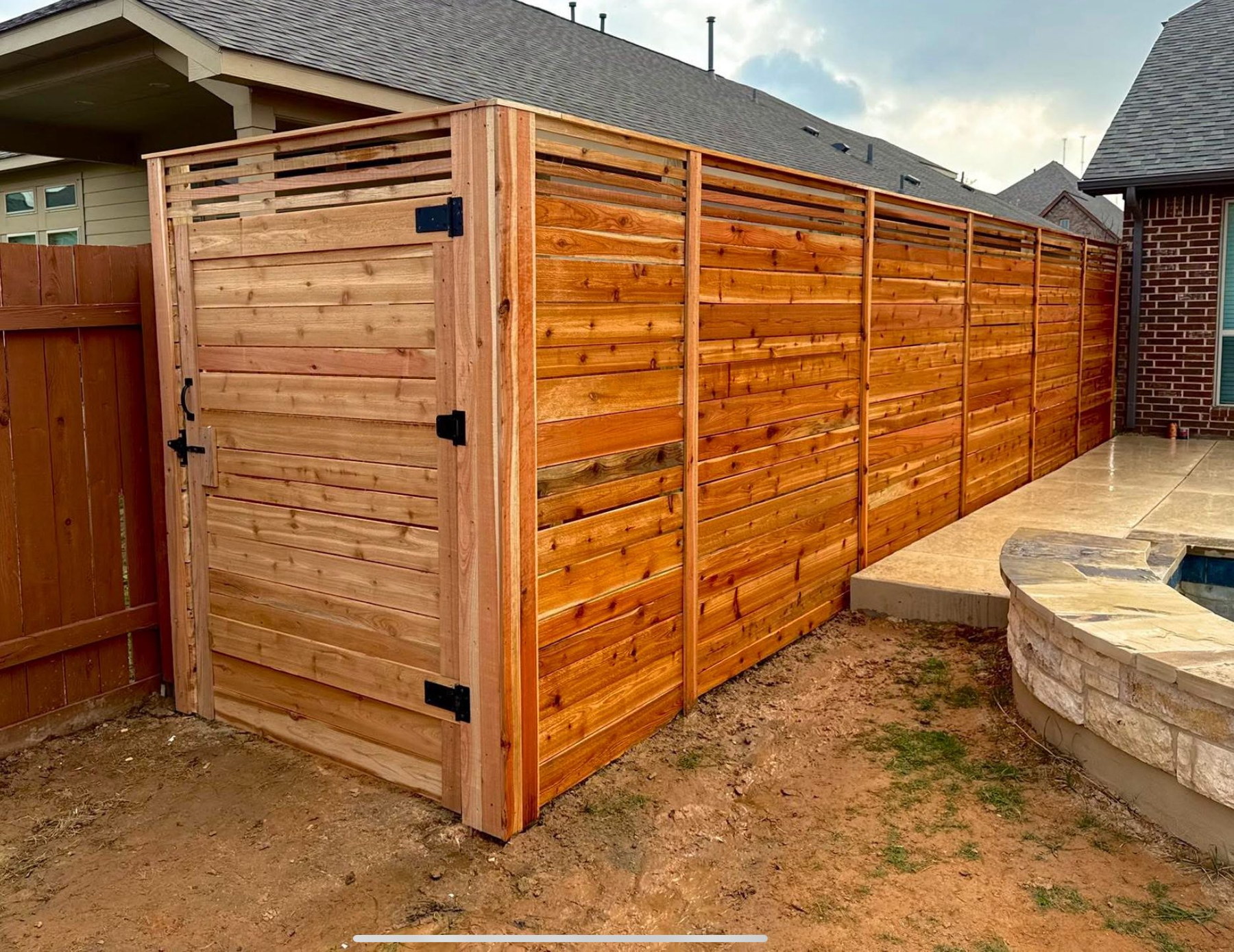
- Horizontal fence
- A fence with boards running sideways between the posts, for a clean, modern look. More →
- Split-rail fence
- An open, ranch-style fence of a few horizontal rails between posts. It marks a boundary but gives no privacy. More →
- Picket
- One of the individual upright boards that make up the face of a fence.
- Rail
- A horizontal board between fence posts that the pickets attach to. Most privacy fences have two or three rails.
- Top cap
- A board run along the top of a fence that covers the picket ends, sheds water and gives the fence a finished look.
- Steel posts
- Galvanized steel fence posts set in concrete, often hidden behind the wood. They do not rot at ground level, which is where wood posts usually fail. More →
- Linear foot
- A measurement along the length of a fence. Fences are usually priced per linear foot. More →
- Drive gate
- A double gate wide enough for a vehicle or trailer to pass through.
Pergolas, covers and porches
- Pergola
- An outdoor structure with posts, beams and open rafters overhead. It gives filtered shade, not rain cover. More →
- Patio cover
- A structure with a solid roof over a patio or deck, either attached to the house or freestanding. It gives full shade and keeps the rain off. More →
- Pavilion
- A freestanding square or rectangular structure with a solid roof, often over a patio, outdoor kitchen or seating area. More →
- Gazebo
- A freestanding structure with a solid roof that rises to a point, usually six- or eight-sided, often on a raised floor. More →
- Attached vs. freestanding
- An attached structure connects to the house with a ledger; a freestanding one stands on its own posts. Attached covers usually need flashing and must match the roofline. More →
- Tongue-and-groove ceiling
- A finished wood ceiling under a patio cover, made from boards that lock edge to edge. More →
- Screened porch
- A covered outdoor room enclosed with insect screen instead of glass. It is not heated or cooled. More →
- Sunroom
- A glazed, insulated room added to a house. It is built and permitted as an addition, unlike a screened porch. More →
Roofing
- Architectural shingle
- A thick, layered asphalt shingle with a dimensional look. Also called a dimensional or laminated shingle, it is the standard choice for most Austin homes. More →
- 3-tab shingle
- A thin, flat, single-layer asphalt shingle. It is the budget option and is being phased out in many neighborhoods. More →
- Class 4 shingle
- A shingle with the highest impact rating under the UL 2218 test. In Texas, impact-resistant roofs can qualify for an insurance discount, and each insurer sets the amount. More →
- Standing seam metal roof
- A metal roof made of long panels joined by raised, interlocking seams, with the fasteners hidden. More →
- Underlayment
- A water-resistant layer installed over the roof deck, under the shingles or metal, as a second line of defense against leaks.
- Roof decking
- The plywood or OSB sheets the roof covering is fastened to. Rotted decking is usually found and replaced during a tear-off. More →
- Drip edge
- A metal strip along the roof edges that guides water into the gutters and away from the fascia.
- Roofing square
- A unit roofers use to measure roof area. One square equals 100 square feet.
- RCV and ACV
- Insurance terms. Replacement cost value (RCV) pays to replace damage with new materials; actual cash value (ACV) pays only the depreciated value. More →
- Wind and hail deductible
- A separate deductible some Texas policies apply to wind and hail claims, often set as a percentage of your dwelling coverage rather than a flat amount. More →
Siding
- Fiber cement siding
- Siding made from cement, sand and cellulose fiber. It resists rot, termites and fire. James Hardie is the best-known brand, which is why people call it Hardie board. More →
- Engineered wood siding
- Siding made of wood strands bonded with resin and treated to resist rot and termites. LP SmartSide is the best-known brand. More →
- Lap siding
- Horizontal boards that overlap the board below, the most common siding look. More →
- Board and batten
- Vertical siding panels with narrow strips, called battens, covering the seams. More →
- Sheathing
- The layer of plywood or OSB on the outside of the wall framing, under the house wrap and siding. More →
- House wrap
- A weather-resistant barrier wrapped over the sheathing that keeps water out of the wall while letting moisture escape.
- Elevation
- One side or face of a house. Siding repairs and replacements are often quoted by elevation. More →
Concrete and hardscape
- Broom finish
- Plain concrete brushed with a broom while it sets to give it a non-slip texture. It is the most affordable patio finish. More →
- Stamped concrete
- Concrete pressed with patterned mats while wet so it looks like stone, brick or wood. More →
- Stained concrete
- Concrete colored with an acid-based or water-based stain after it cures, for a mottled or even color. More →
- Exposed aggregate
- A concrete finish where the top layer is washed away to reveal the stones in the mix, giving a pebbled, slip-resistant surface. More →
- Pavers
- Individual concrete or stone units laid over a compacted base. Single pavers can be lifted and replaced. More →
- Flagstone
- Flat slabs of natural stone, often limestone in Central Texas, laid in sand or mortar for patios and paths. More →
- Control joint
- A groove cut or tooled into concrete so that it cracks in a straight line at the joint instead of randomly.
- Expansive clay
- Soil that swells when wet and shrinks when dry. Much of east Austin sits on it, and it can heave slabs, footings and fence posts. More →
- Retaining wall
- A wall that holds back soil where the ground changes level. Inside Austin city limits, walls over 4 feet, measured from the bottom of the footing, need a permit. More →
- Face foot
- A unit for pricing retaining walls: one foot of wall length by one foot of exposed height. More →
Permits, HOAs and contracts
- HOA architectural review
- The approval process many homeowners associations require before exterior changes like fences, decks or covers. The committee may be called the ARC or ACC. More →
- CC&Rs
- Covenants, conditions and restrictions: the recorded rules for a neighborhood or HOA, including what you can build and how it must look. More →
- Setback
- The minimum distance a structure must sit from a property line, set by the city or the HOA. More →
- Building permit
- Official approval from the city or county to build. Small projects can be exempt, but most attached or raised structures need one. More →
- Line-itemed quote
- A quote that lists the cost of each part of the job separately, such as materials, labor and extras, so you can compare bids and trim items. More →
- Lien waiver
- A signed release confirming a contractor or supplier has been paid, so they cannot place a lien on your home for that work. More →
Still not sure what a quote means? Call or text John at (512) 587-3914. He will walk you through it, even if we are not the ones building it.
Get a free, line-itemed quote →