
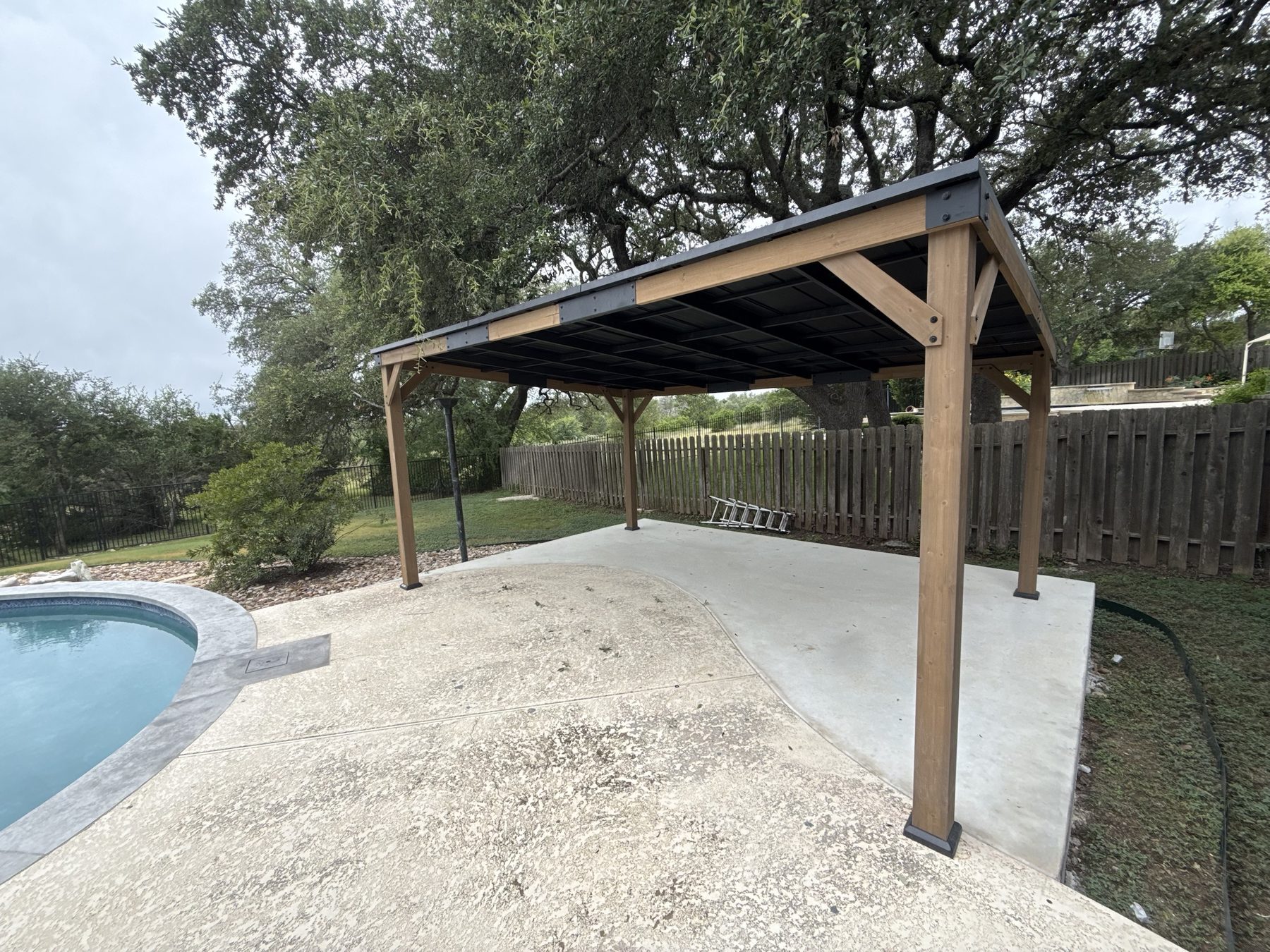
A patio cover is the highest-return structure you can put in an Austin backyard, and it is not close. A deck gives you a surface. A cover gives you months. Most Central Texas backyards are unusable from June through September, and the thing standing between you and about a hundred extra usable evenings a year is a roof.
This page covers what a covered patio actually costs here, the attached versus freestanding decision, which roof to put on it, and the things that go wrong when it is built badly.
Want an open-top structure instead? If it is filtered shade and airflow you are after rather than rain cover, see cedar pergolas in Austin. This page is about solid roofs.
What a patio cover costs in Austin
| Structure | 12x12 to 12x16 | 14x20 and up |
|---|---|---|
| Attached cover, shingle roof to match house | $14,500 to $22,000 | $22,500 to $38,000 |
| Attached cover, standing-seam metal | $17,500 to $26,000 | $26,500 to $44,000 |
| Freestanding covered pavilion | $16,500 to $25,000 | $25,500 to $42,000 |
| Lean-to cover off the back wall | $11,500 to $17,000 | $17,500 to $28,000 |
| Polycarbonate or clear-panel roof | $9,500 to $15,000 | $15,500 to $24,000 |
| Tongue-and-groove ceiling upgrade | add $2,700 to $5,600 | add $4,000 to $8,500 |
| Fans, recessed cans and outlets | add $900 to $2,400 | add $1,500 to $4,000 |
| New concrete slab underneath | add $4,000 to $9,000 | add $8,000 to $16,000 |
Greater Austin installed pricing for 2026, including footings, the permit and the HOA packet. The two biggest swings are whether a slab already exists and whether the structure ties into the house.
For the full size-by-size breakdown including open-top structures, see our 2026 Austin pergola and patio cover cost guide.
Attached or freestanding
Almost everyone starts by assuming the cover attaches to the house, because that is where the slab is. It is the right answer maybe two thirds of the time.
Attached costs less for the same square footage, because the house carries one side of the structure. It reads as part of the home rather than an addition, which matters both for HOA approval and at resale. It is the right call when the existing patio is where you actually want to sit, and when the roofline gives you enough height to tie in above the door and window heads without the ceiling closing in on you.
Freestanding wins more often than people expect in Austin. On a single-storey home with a low roofline, tying in forces the cover down to a height that feels like a carport. On sloped Hill Country lots, the flat usable part of the yard is frequently not against the house. A freestanding structure puts the shade where the sun actually is, which on a west-facing backyard is rarely the back wall. And it means no new penetration in a roof you may not want touched.
The test we use: stand in the yard at four in the afternoon in July, when the space is genuinely unusable. Wherever you move to get out of the sun is where the structure belongs.
Choosing the roof
- Architectural shingle matched to the house. The most common Austin cover and the one that looks like it came with the home. Heavier than the alternatives, so posts and footings size up accordingly. Best choice when the cover is visible from the street or when the HOA is particular.
- Standing-seam metal. Costs more up front and reflects a great deal of heat, which is worth real money on newer subdivisions where the trees have not filled in. Lasts far longer than shingle. Louder in rain, which people either love or do not.
- Polycarbonate or clear panels. The underrated option. Keeps rain off without darkening the rooms behind it. Worth serious consideration when the cover would otherwise sit directly outside a kitchen or living room window, which is the single most common regret we hear after the fact.
- Louvered aluminium. Adjustable slats, open for breeze and closed for rain. The most expensive by a distance. A legitimate product and we will quote it, but for most Austin backyards a solid roof with good fans does the same job for a lot less.
- Insulated roof panels. Worth it only if you are eventually enclosing the space. If a screened porch or a sunroom is in your five-year plan, say so now and we will build the structure to take it.
The upgrade that changes how it feels
If you take one recommendation from this page, finish the ceiling.
Bare rafters and exposed roof decking read as a carport. A tongue-and-groove pine or cedar ceiling with recessed cans and a fan reads as a room, and people use it completely differently. It is the single thing homeowners tell us afterwards they are gladdest they spent money on, and the single thing most often skipped to save a few thousand and regretted.
The other one to get right at build time is electrical. Fans, cans and outlets run in conduit during the build cost a fraction of what they cost retrofitted. In an Austin summer the fan is not a luxury, it is the difference between a cover you sit under and a cover you look at. Nothing undoes an outdoor room faster than an extension cord running out through a window.
Where patio covers go wrong
The tie-in
This is the one that costs real money later. Where the cover meets the house, flashing has to be integrated into the existing roof, not caulked to it. Caulk is a five-year material. A properly flashed tie-in is a permanent one. If a quote does not mention flashing, ask, because the leak will not show up until the second big storm and by then it is in your ceiling.
Posts sized for looks instead of load
A solid roof is heavy, and wind uplift in Central Texas is real. Four-by-four posts look slender and are frequently undersized for a shingle roof at any meaningful span. Six-by-six is the honest minimum on most covers we build, and the structural calculation is part of why an attached cover needs an engineer's letter for the permit.
Footings in our soil
Much of the Austin area sits on expansive clay that moves seasonally, and much of Williamson County sits on limestone close to the surface. Both need real footings dug to depth. A post on a surface block will move, and a structure that moves opens its tie-in.
Drainage nobody thought about
A cover changes where several hundred square feet of water goes. On a lot that already sheets toward the house after a storm, adding a roof without planning the drainage makes an existing problem worse. This gets looked at before we quote, not after.
Building before you know about the slab
If you are pouring concrete now and thinking about a cover later, say so. Setting footings for a future structure at pour time costs $400 to $1,200. Cutting into finished concrete a year later costs several times that and never looks as good.
Not sure what your backyard needs? John will walk the space, look at sun angle, roofline height and where water runs, and price the options side by side. No charge and no pressure.
Book my free design walk →Permits and HOA review around Austin
A solid-roof patio cover normally needs a permit, and an attached one commonly needs an engineer's letter showing the structure and the tie-in. Inside the city limits that goes through the City of Austin. Outside it, you are dealing with Travis, Hays or Williamson County, and the timelines differ. We work out which applies to your address before quoting.
HOA architectural review is what actually delays people. Most Austin-area subdivisions review exterior structures, and many have rules on roof pitch, materials, colour and how close a structure can sit to the rear setback. Review commonly runs two to four weeks. We prepare and submit the packet, with elevations and material samples, and we start it the day you sign rather than the week before we are due on site.
How the build runs
- Free on-site design walk. Sun angle, roofline height, trees, slope, drainage, and what the lot will actually carry.
- Line-itemed quote. Structure, roof, ceiling, electrical and concrete separated out, so you can see what the metal roof or the T and G ceiling is costing and decide for yourself.
- Permit and HOA packet. We prepare and submit both, including the engineer's letter where the tie-in needs one.
- Footings and posts. Dug to depth, set plumb, braced and located around tree roots rather than through them.
- Frame, roof and tie-in. Beams and rafters sized for the span, flashing integrated into the existing roof.
- Ceiling, electrical and finish. Tongue-and-groove up, fans and cans wired, cedar sealed or stained.
- Clean and walk it. Magnet sweep for fasteners, and we walk the finished structure with you.
Where we build covered patios
We build patio covers across greater Austin and throughout Travis, Hays and Williamson counties. Local pricing, permit offices and HOA rules genuinely differ by city, so go straight to your local page where we have one:
- Patio covers and pergolas in Cedar Park → · decks →
- Patio roofs in Round Rock and Brushy Creek →
- Covered patios in Buda →
- South Austin outdoor living →
- Lakeway → · Dripping Springs → · Kyle → · Manchaca →
Weighing it against the alternatives
A cover is not always the right answer. If you want the space usable without mosquitoes, a screened porch is the better build and it starts from the same structure. If the ground is flat and you mainly need a surface, a concrete patio costs less per square foot and gives a future cover something solid to sit on. If you want the surface raised to meet a back door, that is a deck. Our guide to deck vs patio vs pergola lays the three out side by side.
Why Austin homeowners call JB
- John walks every design himself. The person pricing your cover is the person responsible for building it.
- Engineer's letters and permits handled. Including the HOA architectural packet, submitted the day you sign.
- The tie-in is flashed, not caulked. We will show you the detail before we close it up.
- Daily progress photos by text. You always know where the job stands.
- 5.0 stars on Google. Read the reviews from your neighbors.
Ready for a free patio cover quote? Call or text (512) 587-3914, or send a photo of the back of the house and John will tell you what the roofline will allow.
Get my free patio cover quote →Austin patio cover questions, answered
How much does a patio cover cost in Austin?
A solid-roof patio cover in Austin typically runs $14,500 to $22,000 at 12x12 to 12x16, and $22,500 to $38,000 at 14x20 and larger, with a shingle roof matched to the house. Standing-seam metal runs roughly 20 percent above that. An open-top attached structure is $10,500 to $16,000. If there is no slab to build on, add $4,000 to $16,000 for the concrete.
What is the difference between a patio cover and a pergola?
A patio cover has a solid roof, so it keeps rain off and creates genuine shade underneath. A pergola has spaced rafters, so it filters sun and stays breezy but will not keep you dry. If the problem is heat on a shaded lot, a pergola is enough and it is cheaper. If you want the space usable in the rain, or usable at all on a west-facing lot with no tree canopy, you want a solid cover.
Do I need a permit for a patio cover in Austin?
Usually yes for a solid-roof structure. The City of Austin permits covered patios, and an attached cover tying into an existing roofline commonly needs an engineer's letter as part of the submission. Homes in the extraterritorial jurisdiction or in Travis, Hays and Williamson counties go through a different office. We determine which applies, pull the permit, and prepare the HOA architectural packet as part of the job.
Can you attach a patio cover to my existing roof?
Yes, and the flashing detail is the part that decides whether it works. Done properly the tie-in sheds water and you never think about it again. Done badly you have added a leak to a roof that did not have one. The other consideration is headroom: on a low single-storey Austin roofline, tying in can force the cover down to a height that feels cramped, and a freestanding structure often ends up being the better build.
How long does it take to build a patio cover?
One to three weeks on site depending on size, roof type and whether the ceiling is finished. The longer half is usually before that. HOA architectural review commonly runs two to four weeks in Austin-area subdivisions, and permitting runs alongside it, so we submit the packet the day you sign to keep the two in parallel.
What is the best roof for a patio cover in Texas?
Shingle matched to the house is the most common and looks original rather than added on, which matters for both HOA approval and resale. Standing-seam metal costs more and reflects a great deal of heat, which is worth real money on a lot without mature canopy. Polycarbonate keeps rain off without darkening the rooms behind it, and is worth considering when the cover sits right outside a kitchen or living room window.
Can a patio cover go over an existing concrete slab?
Usually yes, and it is the cheapest way to build one. The slab has to be thick enough and sound enough to carry the post loads, which we check before quoting. Where it is not, posts get their own footings dug beside or through the slab. If you are pouring new concrete and a cover is anywhere in your plans, say so before the pour, because setting footings at pour time costs a few hundred dollars and cutting into finished concrete later costs several times that.
Who builds patio covers in Austin, TX?
JB Contracting and Property Services builds covered patios, patio roofs and pavilions across greater Austin, including South Austin, Cedar Park, Round Rock, Brushy Creek, Buda, Kyle, Leander, Lakeway, Dripping Springs and Manchaca. We are family owned, licensed and insured, and rated 5.0 on Google. Owner John Bernard walks every design himself and handles the permit and the HOA submission.
Planning more than a cover? See outdoor living in Austin for how the deck, the concrete, the roof and the lighting fit together, and the order that saves the most money.