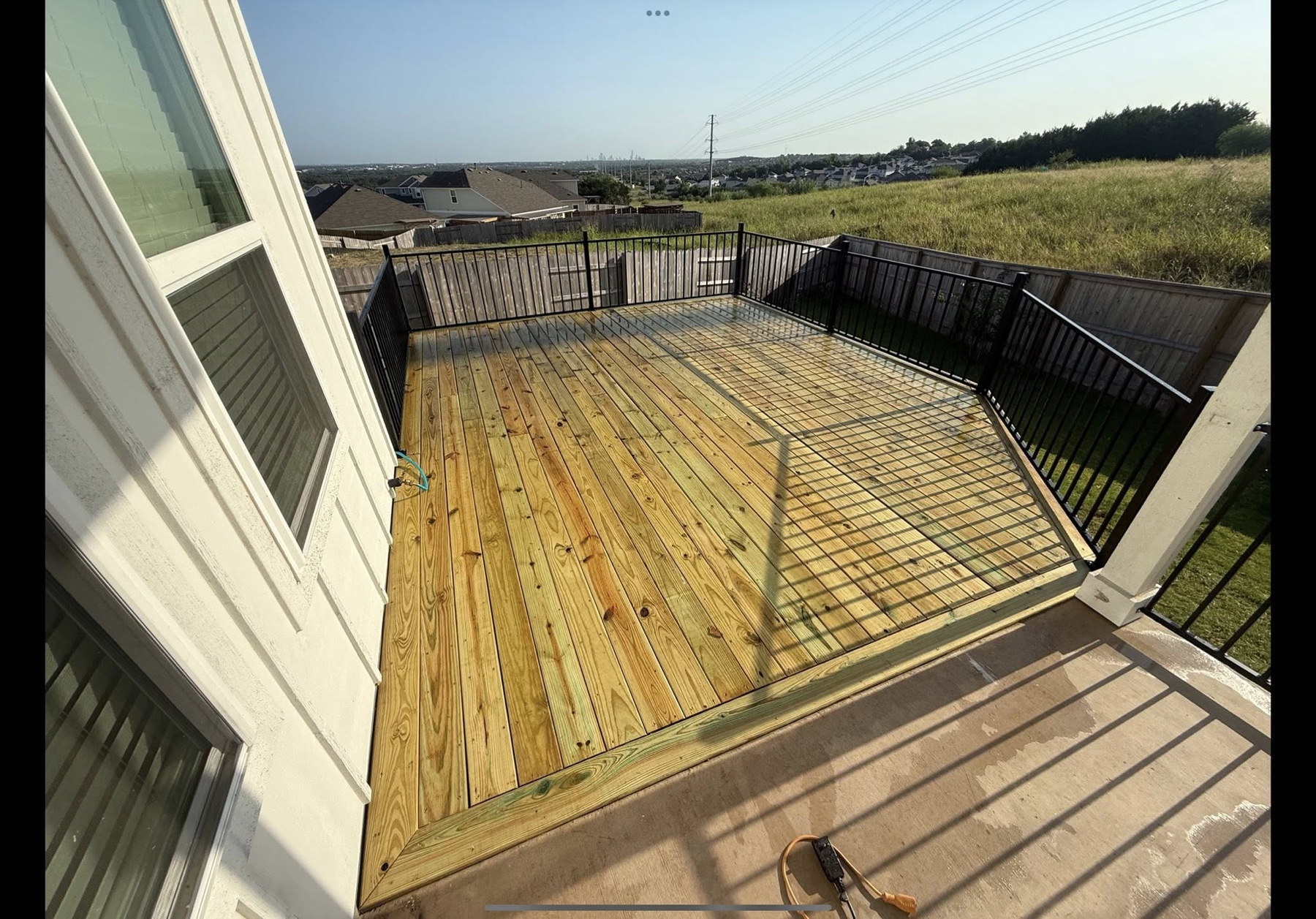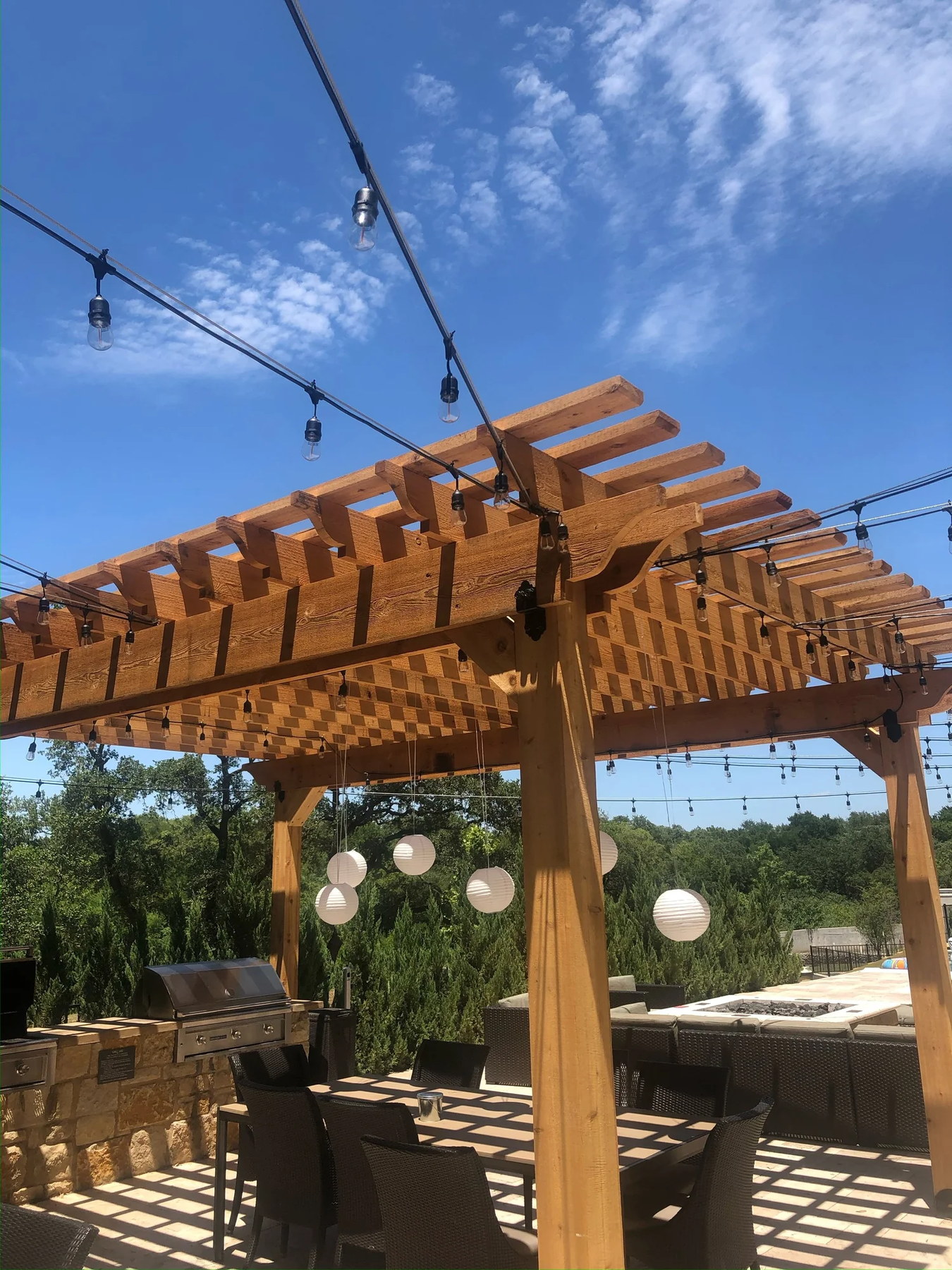

People use these three words interchangeably, and contractors do not help by using them loosely too. They are genuinely different structures, they cost different amounts, and they solve different problems. Picking the wrong one is how people end up with a beautiful thing in the back yard that nobody sits in.
Here is what each one actually is, what it costs in the Austin area in 2026, and how to choose.
The short version
| Gazebo | Pavilion | Pergola | |
|---|---|---|---|
| Shape | Octagon or hexagon | Square or rectangle | Square or rectangle |
| Roof | Solid, rises to a point | Solid, gable or hip | Open beams and rafters |
| Rain cover | Yes | Yes | No |
| Shade | Full | Full | Filtered |
| Floor | Often raised, with railings | Usually on a slab or pavers | Over a slab, deck or pavers |
| Best for | A focal point, a quiet seat | Dining, kitchens, lounging | Light shade, looks, string lights |
| Austin cost, 12x12 to 12x16 | $12,000 to $28,000 | $16,500 to $25,000 | $8,500 to $13,000 |
Gazebo
A gazebo is a freestanding structure with a solid roof, almost always octagonal or hexagonal, with the roof rising to a point, often topped with a small cupola. Traditionally it sits on its own raised floor with railings around the edge and a set of steps up.
What it is good at: being a destination. A gazebo at the far end of a garden, under an oak, is somewhere to walk to with a coffee. It reads as a feature rather than an extension of the house, and it photographs beautifully.
What it is bad at: holding furniture. An octagon wastes its corners, and a rectangular dining table never quite fits. A 12-foot gazebo sounds large until you try to seat eight people in it. The multi-sided roof framing is also slow to build, which is why a custom gazebo costs more per square foot than a pavilion of the same size.
Pavilion
A pavilion is a freestanding structure with a solid roof on posts and open sides, usually square or rectangular, and usually built bigger than a gazebo. Gable roof, hip roof, or a low-slope standing-seam metal roof are all common.
What it is good at: being usable floor space. A dining table fits it. An outdoor kitchen fits along one side of it. A lounge set, a TV, a ceiling fan and a string of cans in a tongue-and-groove ceiling all fit it. It keeps the rain off and it throws real, full shade, which in a Central Texas July is the difference between a space you use and a space you look at.
What to know: it is the most expensive of the three at a given size, it is heavy enough that footings matter, and a solid roof over an outdoor space needs a plan for where several hundred square feet of rainwater goes.
If you want the same thing attached to the house rather than standing on its own, that is a patio cover. See patio covers in Austin for how the two compare and what the tie-in involves.
Pergola
A pergola has posts, beams and an open grid of rafters overhead, with no solid roof. The rafters break up direct sun into filtered shade and let air move through.
What it is good at: being the cheapest structure that makes a patio feel like a room. It looks great with string lights and climbing plants, it keeps a yard feeling open, and on a lot that already has some tree cover it is often all the shade you need.
What it is bad at: rain, entirely. Do not let anyone sell you a pergola as a rain cover. And in full afternoon sun on a west-facing Austin lot, filtered shade is noticeably not the same thing as shade. Rafter depth, spacing and orientation matter a great deal, which we cover on our Austin pergola page.
Which works best in Austin heat?
This is the question that usually decides it.
If the space faces west and has no tree cover, you want a solid roof. The Central Texas sun comes in low and hard from the west in the late afternoon, exactly when you want to be outside, and slatted shade does not stop it. That means a pavilion, or a gazebo if a focal point matters more than floor space.
If there is mature canopy, a pergola is often enough. The trees are already doing half the work and the pergola does the rest, for a good deal less money.
If you want to use it in the rain, it has to be a solid roof. No pergola does this.
Whatever you build, a ceiling fan earns its cost in July. Run the electrical during the build, because retrofitting it through a finished ceiling costs several times more.
What they cost in the Austin area, 2026
| Structure | 12x12 to 12x16 | Larger |
|---|---|---|
| Freestanding cedar pergola | $8,500 to $13,000 | $13,500 to $22,000 |
| Custom-built wood gazebo, on site | $12,000 to $28,000 | $28,000 and up |
| Freestanding pavilion, shingle or metal roof | $16,500 to $25,000 | $25,500 to $42,000 |
| Tongue-and-groove ceiling | add $2,700 to $5,600 | add $4,000 to $8,500 |
| Fans, cans and outlets | add $900 to $2,400 | add $1,500 to $4,000 |
| New slab or pavers underneath | add $4,000 to $9,000 | add $8,000 to $16,000 |
Greater Austin installed pricing for 2026, including footings. The biggest swing is what sits underneath: building on an existing slab is much cheaper than pouring one.
For the size-by-size breakdown of open and covered structures, see the 2026 Austin pergola and patio cover cost guide.
Where it goes on the lot
Before choosing between the three, stand in the yard at four in the afternoon in July and notice where you move to get out of the sun. That is where the structure belongs, and it often is not where people first picture it.
A few Austin-specific things decide the placement. Live oak root plates are wide and shallow, so footings get laid out around them, not through them. Limestone sits close to the surface across much of the west side, which is great for bearing and slower for digging. Expansive clay on the east side moves with the seasons, so footings go deeper. And drainage: a solid roof sheds a lot of water in one spot, so plan where it lands before the posts go in.
Permits and HOA review
A solid-roof structure often needs a permit, and any electrical for fans and lighting always does. Small open pergolas sometimes do not. It depends on size, height, and whether you are inside the City of Austin or in Travis, Hays or Williamson County. Most subdivisions also run architectural review on backyard structures, commonly two to four weeks. We check both before quoting and submit the packet the day you sign. Our HOA approval guide covers how the review works.
Not sure which one your yard wants? John will walk the space, look at the sun angle, the trees and the drainage, and price the options side by side. No charge and no pressure.
Book a free design walk →Our honest pick
For most Austin backyards, a pavilion. It gives you the most usable space for the money, it keeps the rain off, it throws the shade a Texas afternoon actually needs, and it takes a table, a kitchen and a fan without argument.
Choose a pergola if you have tree cover already, want the lightest and cheapest option, or mainly want the look and the string lights. Choose a gazebo if you want a focal point at the end of the garden more than you want floor space, and you love the look enough to pay for the framing.
And if a solid roof is anywhere in your future, say so before a pergola goes up. Sizing the posts and footings for a roof at build time costs very little. Retrofitting one later often means starting over.
Planning the whole back yard rather than one structure? See outdoor living in Austin for how to sequence the concrete, the structure and the lighting so nothing gets cut into later.
Gazebo, pavilion and pergola questions, answered
What is the difference between a gazebo and a pavilion?
A gazebo is a freestanding roofed structure, usually octagonal or hexagonal, often with a raised floor, railings and a roof that rises to a point. A pavilion is also freestanding with a solid roof, but it is usually square or rectangular, open on all sides and built larger, so it fits a dining table, an outdoor kitchen or a lounge set. Gazebos are a focal point. Pavilions are usable floor space.
What is the difference between a pavilion and a pergola?
The roof. A pavilion has a solid roof, shingle or metal, so it keeps rain off and throws real shade. A pergola has open beams and rafters overhead, so it filters sun and lets air through but will not keep you dry. Pergolas cost less. Pavilions are the one you can actually use in a summer downpour.
Which is cheaper, a gazebo, a pavilion or a pergola?
A pergola is the cheapest of the three. In the Austin area a freestanding cedar pergola runs about $8,500 to $13,000 at 12x12 to 12x16. A custom-built wood gazebo of a similar footprint runs roughly $12,000 to $28,000, because octagonal framing is slow work. A freestanding pavilion runs about $16,500 to $25,000 at that size and $25,500 to $42,000 at 14x20 and up.
Which gives the most shade in Texas?
A solid roof, so a pavilion or a gazebo. A pergola's rafters cut the worst of the direct sun, but in a Central Texas afternoon, with the sun coming in low from the west, filtered shade is not the same as shade. If the space faces west and you want to sit out there in July, you want a solid roof.
Is a gazebo or a pavilion better for an outdoor kitchen or dining table?
A pavilion, almost always. A rectangular table and a run of kitchen cabinets fit a square or rectangular footprint cleanly, and an octagon wastes its corners. A 12-foot gazebo feels generous until you try to seat eight people in it. Pavilions also scale up easily, so the grill, the table and the seating can all live under one roof.
Do I need a permit for a gazebo or pavilion in Austin?
Often, yes, for a solid-roof structure, and electrical for fans and lights always needs one. Small open pergolas sometimes do not. The answer depends on size, height, whether the property is inside the City of Austin or in Travis, Hays or Williamson County, and your HOA's rules. We check before quoting and pull the permit and HOA packet as part of the job.
How long does a gazebo or pavilion last?
Built properly, 25 years and more. Cedar framing with a standing-seam metal roof is the longest-lived combination in Central Texas. The parts that decide it are the footings, which have to be dug to depth for the soil you are on, and the roof, which takes the hail. Kit structures with thin posts and light fasteners are where short lifespans come from.
Can a pergola be converted to a pavilion later?
Sometimes, if it was designed for it. A pavilion roof is much heavier than open rafters, so the posts, beams and footings have to be sized for that load from the start. If a solid roof is anywhere in your five-year plan, say so before the pergola goes up, because upsizing the structure then costs very little and retrofitting it later often means rebuilding it.