If you've searched anything close to "cedar fence cost in Austin," you've probably gotten a wide range of per-foot numbers from contractors. There's a reason: a cheap cedar fence and an honest cedar fence can look identical the day they're installed and tell completely different stories five years later.
Here's what a cedar fence actually costs in Austin in 2026, what's in (and not in) the typical quote, and how to spot a number that's going to lean and rot before its time.
The short answer: real Austin cedar fence pricing in 2026
Most cedar fence installs in greater Austin fall into these ranges. These are total installed prices per linear foot, including posts, pickets, rails, hardware, demo of any existing fence, and cleanup:
| Cedar fence style | Per linear foot, installed | Typical 200-foot backyard |
|---|---|---|
| Side-by-side (standard privacy) | $32 to $48 | $6,400 to $9,600 |
| Board-on-board (overlap, no gaps) | $38 to $55 | $7,600 to $11,000 |
| Shadow-box (alternating, good both sides) | $40 to $58 | $8,000 to $11,600 |
| Horizontal cedar (modern look) | $48 to $72 | $9,600 to $14,400 |
| Split-rail / ranch cedar (Hill Country) | $22 to $38 | $4,400 to $7,600 |
For larger installs (300+ feet), the per-foot price often drops 5 to 10 percent because mobilization is fixed. For smaller installs (under 100 feet), it usually rises 10 to 20 percent. If a contractor quotes you well below the low end of these ranges, something's getting cut, usually the posts, the hardware, or the picket grade.
Want a real number for your fence? Send us a rough length and style and we'll walk the property, measure, and write up an honest, line-itemed quote. Free, no obligation.
Get my fence quote →What drives cedar fence cost up or down in Austin
1. Post material and depth (the most important variable)
The posts are the part of the fence that fail first. They're also where bad contractors save the most money. Cedar 4x4 posts (typical on a $32-per-foot quote) last 12 to 15 years in Austin's soil. Pressure-treated 4x4 posts last 20+ years and cost about $4 to $7 more per post. Steel posts (galvanized or vinyl-coated) last 40+ years and cost $12 to $20 more per post but eliminate the failure mode entirely. We install treated posts as our standard and steel posts on long-run or premium installs.
Just as important as the post material: how deep is it buried? The minimum that works in Austin's expansive clay is 30 inches with at least 8 inches of concrete around it. The cheap installer who goes 18 inches with a bag of dry concrete tossed in the hole is selling you a fence that leans in 3 years. Ask specifically.
2. Picket grade and thickness
"Cedar pickets" come in three grades: standard, premium, and clear. Standard (#2 Common) is what most fences are built with, has visible knots but holds up well. Premium is mostly knot-free with cleaner grain. Clear is no knots, premium look, costs 50 to 100 percent more. Picket thickness ranges from 1/2 inch (cheap, warps easily) to 5/8 or 3/4 inch (standard, holds up much better in Texas heat). The right combo for most Austin fences is #2 Common at 5/8 inch.
3. Rails (the boards your pickets attach to)
A 6-foot fence needs at least 3 rails (top, middle, bottom). Cheap fences sometimes go with 2. With Texas wind and the expansion-contraction of cedar in our climate, 2-rail fences sag noticeably within 2 to 3 years. Rails should be cedar 2x4 (not 2x3) and should be properly notched into the posts or attached with galvanized brackets. Bracket choice matters: cheap zinc-plated brackets corrode in 5 years.
4. Hardware and fasteners
Nails or screws? Galvanized or stainless? Ring-shank or smooth? The hardware on a cedar fence is the difference between a $35 and a $45 per-foot quote. We use hot-dipped galvanized ring-shank nails or coated structural screws on every fence. Stainless costs more and is worth it on premium installs.
5. Terrain and access
Flat lots are cheapest. Sloped lots cost more because each section has to be stepped or contoured to the grade. Lots with limestone bedrock (common in West Austin and the Hill Country) cost more because we sometimes have to switch from auger to hammer drill on every post. Lots with no equipment access (where we have to wheelbarrow concrete 100 feet through a side gate) cost more in labor.
6. Demo of the old fence
If we're replacing an existing fence, demo and haul-off adds $4 to $8 per linear foot. For a 200-foot fence, that's $800 to $1,600. Some contractors leave this out of the headline number and add it on. Always ask.
Cedar fence styles in plain English
Side-by-side (standard privacy)
The most-installed fence style in Austin. Pickets butted edge to edge with small visible gaps as they shrink in the heat. Cheapest cedar style. Good privacy. Visible from one side (the "good side" where you don't see the rails), backside shows the rails. Standard practice is good side facing the neighbor.
Board-on-board (BOB)
Pickets installed in two layers, with the back layer covering the gaps between the front layer. Total privacy, no gaps even when the wood shrinks, and a richer visual texture. About 15 to 25 percent more than side-by-side because of the doubled material.
Shadow-box (alternating)
Pickets alternating front and back of the rails. Looks good from both sides (no "ugly side"), partial privacy with light airflow. The choice when you want the fence to look intentional from your yard AND the neighbor's. Often required by HOAs that mandate "good side out both directions."
Horizontal cedar
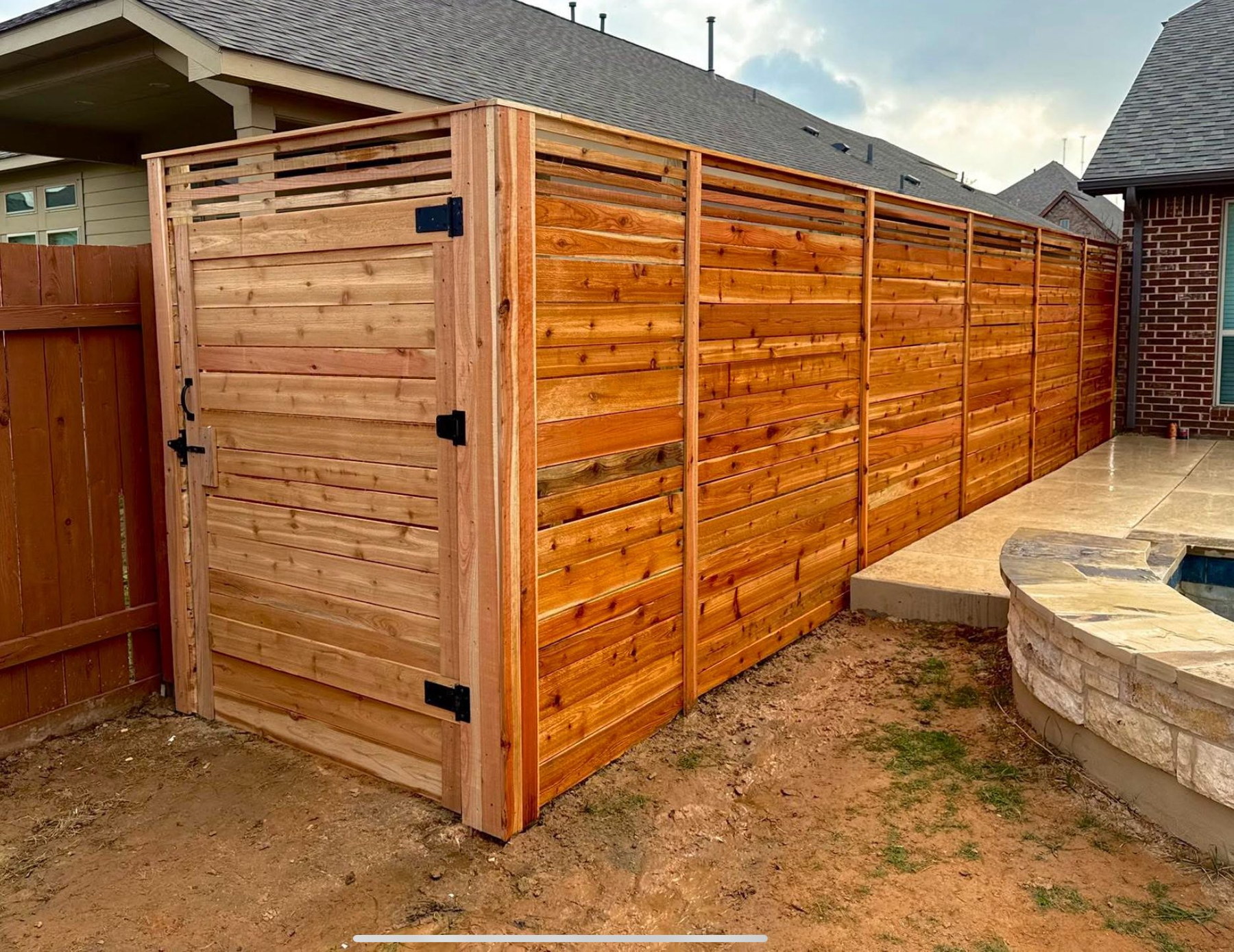
Cedar boards installed horizontally instead of vertical pickets. Modern look. Popular on contemporary and modern-farmhouse homes. Costs more per foot because the boards have to be wider (5 to 8 inches typical) and the post spacing has to be tighter (6 feet max instead of 8). Beautiful but pricier.
Split-rail / ranch cedar
Two- or three-rail open ranch fencing. Used on Hill Country acreage, larger lots, and front-yard property lines where privacy isn't the goal. Much cheaper per foot than privacy fence. Won't keep small dogs in.
Cedar fence gate costs in Austin
Most cedar fence quotes are for the linear run only. Gates are a separate line item:
- Standard 4-foot walk gate: $350 to $750 each, depending on hardware quality and frame.
- Standard 6-foot walk gate: $450 to $900 each.
- Side-yard double gate (8 to 10 feet, for vehicle access): $900 to $1,800 each.
- Custom designed entry gate (curved top, decorative inserts, premium hardware): $1,200 to $4,000+ each.
- Drive-through 12 to 16-foot gate with frame stiffener: $1,800 to $4,500 each.
- Automatic gate motor and controls: $1,500 to $4,500 extra on top of the gate.
Stain, seal, and protection
Raw cedar weathers to a soft silver-grey in 6 to 12 months in Austin's sun. Some homeowners love that look. Others want to keep the warm reddish-brown forever. Options:
- Leave it raw: $0. Re-weather every 6 to 12 months naturally.
- Clear sealer (transparent, lets cedar age but slows it): $1.50 to $3.00 per square foot. Reapply every 2 to 3 years.
- Semi-transparent stain (cedar tone, holds color): $2.00 to $4.00 per square foot. Reapply every 3 to 5 years.
- Solid stain or paint: $2.50 to $5.00 per square foot. Reapply every 4 to 6 years.
For a typical 200-foot, 6-foot-tall fence, that's about 1,200 square feet of stainable surface. Semi-transparent stain ranges $2,400 to $4,800 for the full job, including labor. We recommend staining 4 to 8 weeks after install to let the wood fully dry out.
How long does a cedar fence install take?
Most residential cedar fence installs take 2 to 5 working days from post-set to finish. Day 1 is usually demo (if there's an existing fence) and post layout. Day 2 is post-setting in concrete. Day 3 is letting the concrete cure (we sometimes do other prep on this day or work on other sections). Day 4 to 5 is rails, pickets, and trim. Longer fences (400+ feet) or fences with multiple gates can run 5 to 8 days.
Permits aren't usually required in most Austin jurisdictions for residential fences under 6 feet, but HOA architectural approval is. We pull the HOA submission together and handle it as part of every job.
Where to save on cedar fence cost (and where not to)
- Pick side-by-side over board-on-board if budget is tight. Side-by-side gives you 90 percent of the privacy for 70 to 80 percent of the cost.
- Skip horizontal unless you really want the look. Horizontal is beautiful and 50 percent more expensive. If you'd rather have the money in landscaping or a deck, go vertical.
- Get the posts right. Don't save $200 on posts to spend $7,000 replacing a leaning fence in 8 years.
- Bundle the demo. If you're replacing an existing fence, having us handle demo is usually cheaper than hiring it separately because we already have the truck and crew on-site.
- Stain after 4 to 8 weeks. Don't stain right after install (the wood is too wet for stain to absorb). Don't wait years (it'll need pressure-washing first).
- Choose #2 Common cedar, not clear cedar. Knots are character. Save $1,000 to $3,000 on the picket upgrade.
How to spot an underpriced cedar fence quote
If a contractor quotes you 25 percent below the ranges in this guide, ask:
- How deep are the posts buried? (Should be at least 30 inches, with 8+ inches of concrete.)
- What's the post material? (Treated 4x4 or steel is what holds up. Plain cedar 4x4s are the cheap default that fails first.)
- How many rails per section? (Should be 3 for a 6-foot fence.)
- What's the picket thickness? (5/8 inch is standard. 1/2 inch warps.)
- What's the picket grade? (#2 Common is the honest standard.)
- What hardware? (Hot-dipped galvanized ring-shank nails OR coated structural screws. Not zinc-plated.)
- Is demo and haul-off included?
- Is the HOA submission included?
If the answers come back vague, the quote that looks cheaper today is going to be a leaning, warped, sagging problem in 5 years.
Want an honest fence quote? Tell us the rough length and style and we'll come walk the property, check the grade, and write up a transparent, line-itemed price.
Get my fence quote →What to budget for a cedar fence in Austin
A standard 200-foot cedar privacy fence in Austin in 2026 will cost you somewhere between $6,400 and $11,000 installed. Horizontal modern cedar pushes that to $9,600 to $14,400. Add $400 to $900 per walk gate, $900 to $1,800 per double gate, and $2,400 to $4,800 if you want it stained.
The biggest cost drivers are style and length. The biggest quality drivers are the posts, the rails, and the hardware, none of which look different on day one and all of which decide whether your fence is still standing straight in year 15. The cheapest cedar fence in Austin is the right one installed once.
Cedar fence questions from Austin homeowners
How much does a cedar fence cost in Austin?
A standard 6-foot cedar privacy fence in Austin typically runs $32 to $55 per linear foot installed. A 200-linear-foot backyard fence (a common suburban yard) usually lands between $6,400 and $11,000 installed, including posts, pickets, rails, hardware, and demo of the old fence.
How long does a cedar fence last in Texas?
A properly installed cedar fence in Austin lasts 15 to 25 years. The biggest factors are post depth (should be at least 30 inches in concrete), post material (cedar 4x4s last 12 to 15 years, treated posts can last 20+), and whether the fence is stained or sealed regularly.
Cedar vs pressure-treated fence, which is better?
Cedar costs 25 to 50 percent more upfront but lasts longer, looks better, and ages more attractively. Pressure-treated is cheaper but warps and twists more in Texas heat and turns dark grey-green over time. For a fence you want to see for the next 20 years, cedar is the right call in Austin.
Do I need a permit or HOA approval for a fence in Austin?
Most Austin jurisdictions don't require a city permit for residential fences under 6 feet, but most HOAs require architectural approval. We handle the HOA submission as part of every fence project, including site plan, materials, and stain color samples.