Most fences do not fail all at once. A post starts leaning, the gate starts dragging, a storm takes out a section, and one day you realise you have been propping something up with a brick for a year. The good news is that most of it is fixable, and fixing it is a lot cheaper than a new fence.
This guide covers what fence repair actually costs around Austin in 2026, what causes each problem, and the honest point at which you should stop repairing and replace.
Fence repair cost in Austin, 2026
| Repair | Typical cost | Notes |
|---|---|---|
| Replace a few pickets | $150 to $400 | Matched to the existing boards as closely as possible |
| Replace one wood post | $250 to $450 | Old footing broken out, reset in fresh concrete |
| Replace one post with steel | $300 to $500 | The permanent fix for a post that keeps rotting |
| Straighten a leaning section | $300 to $900 | Usually means resetting the posts, not propping them |
| Rebuild an 8 ft section | $400 to $900 | Posts, rails and pickets |
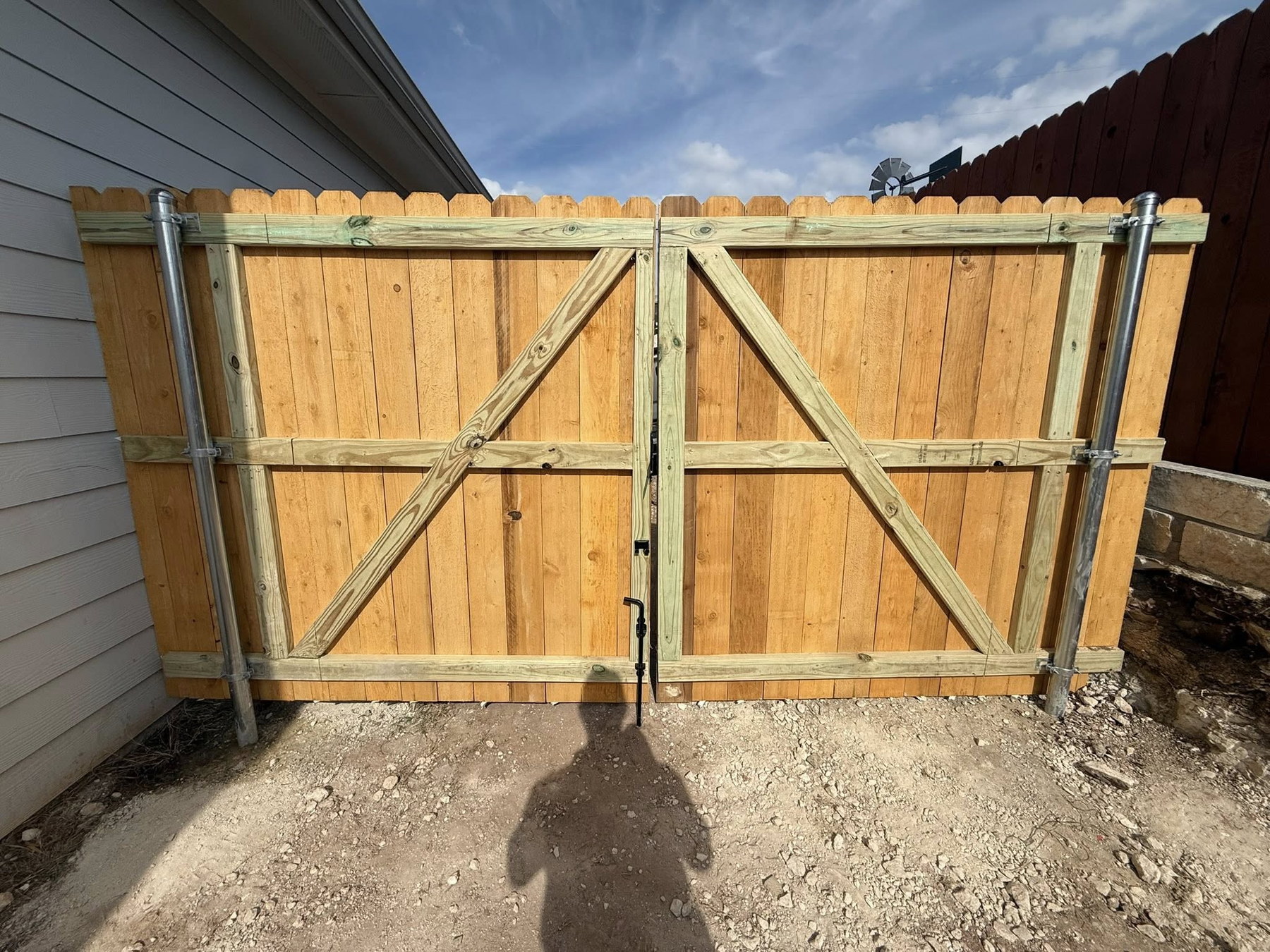
| Fix a sagging gate | $150 to $450 | Brace, re-hang, new hardware |
| Rebuild a gate, steel frame | $600 to $1,400 | Double drive gates at the top of the range |
| Re-stain an existing fence, one side | $3 to $7 per ft | After cleaning and any board replacement |
| Storm-damaged run, replaced | $32 to $55 per ft | Priced as new fence at that point |
Greater Austin pricing for 2026, including materials, labour and haul-off. Access is the main variable: a post behind a pool or a mature shrub bed takes longer than one on an open run.
The honest repair-or-replace test
Repair makes sense when the damage is local and the fence around it is sound. A few posts, one storm-damaged section, a sagging gate, a run of split pickets where a mower caught them. On a fence under roughly twelve years old, that is good money.
Replace instead when any of these are true:
- More than about a third of the posts are loose or rotted. Posts fail from the same cause at roughly the same age, so the ones that have not gone yet are next.
- The pickets are grey, split and soft across the whole run, not just in one spot.
- It is pressure-treated pine past fifteen years, or cedar past twenty-five.
- You are on your second or third repair on the same run. That is the fence telling you something.
- The repair quotes add up past about a third of a new fence. At that point you are paying new-fence money for an old fence.
A useful middle path on an older fence with good pickets and failing posts: replace the posts with galvanized steel and re-hang the existing boards. It costs meaningfully less than a new fence and fixes the part that was actually failing.
What goes wrong, and why
Leaning posts
The most common fence repair in Austin, and it is almost always the posts rather than the boards. Wood posts rot right at ground level, because the concrete collar holds water against the wood exactly where it meets the soil. You cannot see it until the fence leans.
Soil makes it worse. East of I-35 and out toward Kyle, Buda and Round Rock, the clay swells in wet months and shrinks hard in drought, and it works a shallow post loose from both directions. Out west in the Hill Country, posts set in shallow rock pockets rather than dug to depth do the same.
Propping a leaning section with a brace post buys a season. Resetting or replacing the posts fixes it.
Sagging gates
A gate moves thousands of times a year while the rest of the fence just stands there, which is why gates are where cheap fences fail first. The three causes are a hinge post too light or too shallow for the load it carries, a gate frame with no diagonal brace so it racks out of square, and hinges not rated for the weight.
If the latch no longer lines up, look at the hinge post first. If it has moved, the gate will keep sagging no matter how many times it is re-hung.
Storm and wind damage
A six-foot solid privacy fence is effectively a sail, and Central Texas thunderstorms put real load on it. Wind tends to snap weak posts at ground level or lift a whole run, and a falling limb takes out a section at a time. Photograph the damage before anything gets moved if you might claim on insurance.
Split, loose and rotted pickets
Pickets split as they dry, pull their nails as they move, and rot where sprinklers hit them or where soil and mulch are piled against the bottom. Individual pickets are cheap to replace. The honest caveat is matching: new cedar next to ten-year-old weathered cedar is obvious for a year or two until it greys in, and pressure-treated pine is harder still. Staining the whole run after the repair solves it.
Pickets touching the ground
Boards installed tight to the soil wick moisture straight up and rot from the bottom. A fence should have a small gap at grade, or a rot board along the bottom that can be replaced on its own. If your pickets are sitting in the dirt, that is the cause of the next repair.
Not sure whether it is a repair or a replacement? Text a few photos of the worst section and the posts at ground level, and John will tell you straight which one you are looking at.
Send photos for a straight answer →Insurance and shared fences
Insurance. Fences usually fall under the other structures part of a homeowners policy. Sudden damage from wind, a falling tree or a vehicle is often covered. Rot, age and gradual leaning are treated as maintenance and are not. Your deductible frequently makes a small repair not worth claiming, but a long run of storm damage often is, so run the numbers before you decide.
Shared fences. There is usually no automatic obligation for a neighbour to split the cost of a boundary fence, so it comes down to agreement. Plenty of neighbours happily split a repair, and if yours will, put the split and the chosen style in writing before work starts. If you are in an HOA, check whether it has rules about who maintains boundary fences and whether a repair needs approval.
Five ways people waste money on fence repair
- Propping instead of resetting. A brace post on a leaning section buys one season.
- Replacing a rotted wood post with another wood post the same way. Same concrete collar, same soil, same failure in the same number of years. Steel costs a little more once.
- Re-hanging a gate on a post that has moved. It will sag again within months.
- Repairing the same run three times. Add the invoices up. It is often most of a new fence.
- Leaving storm damage for later. A missing section puts load on the posts either side of it, and the damage spreads.
Where we repair fences
Across greater Austin, including South Austin, Cedar Park, Round Rock, Brushy Creek, Buda, Kyle, Lakeway, Dripping Springs and Manchaca.
If it is time for a new one, see privacy fence installation in Austin, compare styles in which privacy fence is best for Austin, or price it out in the 2026 cedar fence cost guide.
Fence repair questions, answered
How much does fence repair cost in Austin?
Most fence repairs in the Austin area run $150 to $900. Replacing a few pickets is typically $150 to $400, a single rotted post set in new concrete is $250 to $450, straightening a leaning section is $300 to $900, and fixing a sagging gate is $150 to $450. Rebuilding a full eight-foot section runs $400 to $900. Once repairs pass about a third of the cost of a new fence, replacing is usually the better money.
How much does it cost to replace a fence post?
A single wood fence post, dug out and reset in fresh concrete, typically runs $250 to $450 in the Austin area, depending on access and how badly the old concrete footing has to be broken out. Replacing it with a galvanized steel post runs about $300 to $500 and removes the rot problem for good. Several posts in the same run usually come in cheaper per post.
Why does my gate sag and can it be fixed?
Gates sag for three reasons: the hinge post is too light or too shallow for the weight it carries, the gate frame has no diagonal brace so it racks out of square, or the hinges were not rated for the weight. All three are fixable. A brace and re-hang runs $150 to $450. If the hinge post itself is leaning, it needs resetting, and a rebuild with a steel frame runs $600 to $1,400.
Should I repair or replace my fence?
Repair when the damage is local: a few posts, a storm-damaged section, a sagging gate, on a fence that is otherwise sound and under about 12 years old. Replace when more than roughly a third of the posts are loose or rotted, when the pickets are grey, split and soft across the run, when it is pressure-treated pine past 15 years, or when repair quotes are passing a third of the cost of a new fence.
Does homeowners insurance cover fence damage?
Often, when the cause is sudden: wind, a falling tree, or a vehicle. Fences usually fall under the other structures part of a homeowners policy. Rot, age and gradual leaning are treated as maintenance and are not covered. Your deductible frequently makes a small repair not worth claiming, but a long run of storm-damaged fence often is, so check the numbers before deciding.
Who pays to fix a shared fence in Texas?
There is usually no automatic obligation for a neighbour to split the cost of a shared fence, so in practice it comes down to agreement. Plenty of neighbours happily split a repair or replacement, and if yours will, it is worth putting the split and the chosen style in writing before work starts. If the fence sits in an HOA, check whether the association has rules about who maintains boundary fences.
Why is my fence leaning?
Almost always the posts. Wood posts rot at ground level, where the concrete collar traps water against the wood. On the east side of Austin, expansive clay swells in wet months and shrinks in drought, working shallow posts loose. And wind load on a solid privacy fence is considerable. A leaning section usually needs its posts reset or replaced rather than just propping up, or it will lean again.
How quickly can you repair a storm-damaged fence?
Most repairs are a single visit, and we move storm damage up the list because a gap in a fence usually means a dog, a pool or a privacy problem that cannot wait. Photograph the damage before anything is moved if you might claim on insurance. Long runs of storm damage are effectively new fence, priced per linear foot, and take two to five days.